
Last Updated: October 22, 2026
Quick Summary
The best laundry detergents sensitive skin clothing requires are fragrance-free, dye-free formulas with plant-based surfactants instead of sulfates. Synthetic fragrances and optical brighteners accumulate with each wash and are the most common irritants, so prioritize detergents that eliminate these ingredients entirely.
- Fragrance-free is not the same as unscented; unscented products often contain masking fragrances that still deposit chemicals on fabric.
- Liquid detergent dissolves completely and rinses more thoroughly than powder or pods, making it the most reliable format for sensitive skin.
- Strip-washing by soaking clothes in hot water for 4-6 hours removes existing detergent residue before switching to a gentler formula.
- Use an extra rinse cycle for the first two weeks after switching detergents to prevent new residue buildup and allow skin to recover.
- Overloading the washer and using cold water increase residue risk; smaller loads and warm water help detergent rinse away completely.
Table of Contents
- Why Laundry Detergent Matters for Sensitive Skin
- Fragrance-Free Laundry Detergent: Why It Matters
- Hypoallergenic Laundry Detergent Options and What the Label Actually Means
- Laundry Detergent Ingredients to Avoid for Sensitive Skin
- How to Remove Detergent Residue from Clothes
- Liquid, Powder, and Pod Formats: Which Works Best for Sensitive Skin
- Practical Tips for Washing Sensitive Skin Clothing
- Frequently Asked Questions
Why Laundry Detergent Matters for Sensitive Skin
Choosing the right laundry detergents sensitive skin clothing requires is one of the most overlooked decisions parents make. Your child's skin touches fabric all day and night, and the wrong detergent can trigger itching, rashes, and discomfort that keeps kids awake or miserable at school.
At Doodlebug's Children's Boutique, we know sensory-friendly clothing only works with the right laundry care. A tag-less shirt or organic bamboo pajamas loses its benefit if detergent residue builds up or synthetic fragrances irritate the skin.
The challenge is finding a detergent that cleans without leaving behind harsh chemicals, dyes, optical brighteners, or fragrances that accumulate with each wash.
Fragrance-Free Laundry Detergent: Why It Matters
Fragrance-free laundry detergent removes the most common irritant that builds up on clothing over repeated washes. Synthetic fragrances cling to fibers and don't fully rinse away, so each wash adds another layer that can trigger reactions even in children without diagnosed skin conditions.

Many parents confuse "unscented" with "fragrance-free." Unscented products often contain masking fragrances that hide other scents, they're still fragrances. Fragrance-free means no added scents at all, period.
The irritation isn't always immediate. Your child might wear a shirt on day one with no reaction, but by day five or six of clothes washed in fragranced detergent, the buildup triggers itching or a rash. Parents blame the fabric or fit when the real culprit is detergent residue.
A fragrance-free formula also avoids introducing new chemical compounds into your child's laundry routine. Some children with sensory processing differences react to synthetic fragrances before anything else, the smell alone can cause distress.
Hypoallergenic Laundry Detergent Options and What the Label Actually Means
Hypoallergenic laundry detergent is formulated to minimize common allergens and irritants, though the term itself isn't regulated by the FDA. Brands can claim "hypoallergenic" without meeting a specific standard, so understanding the label helps you separate genuinely gentle options from marketing.
A truly hypoallergenic detergent typically avoids:
- Synthetic dyes (which can trigger reactions independent of fragrance)
- Optical brighteners (fluorescent compounds that make whites appear brighter but can irritate skin)
- Sulfates (harsh surfactants that strip oils from skin and fabric)
- Preservatives and stabilizers that increase shelf life but add irritation risk
When you see "hypoallergenic" on a bottle, check the ingredient list. If sodium lauryl sulfate, dyes, or fragrance are listed, the claim is marketing, not substance.
For children with eczema or reactive skin, hypoallergenic laundry detergents sensitive skin needs reduce potential irritants and provide a safer starting point.
The best hypoallergenic detergents for sensitive skin are plant-based or use gentler synthetic surfactants that clean effectively without stripping. Zoey Naturals Free & Clean Laundry Detergent, available through Doodlebug's Children's Boutique, is formulated with plant-based ingredients and is free from dyes, fragrances, and sulfates, a true hypoallergenic option designed specifically for sensitive skin.
Laundry Detergent Ingredients to Avoid for Sensitive Skin
Not every child reacts to the same ingredients, but the categories below account for most laundry-related skin complaints.
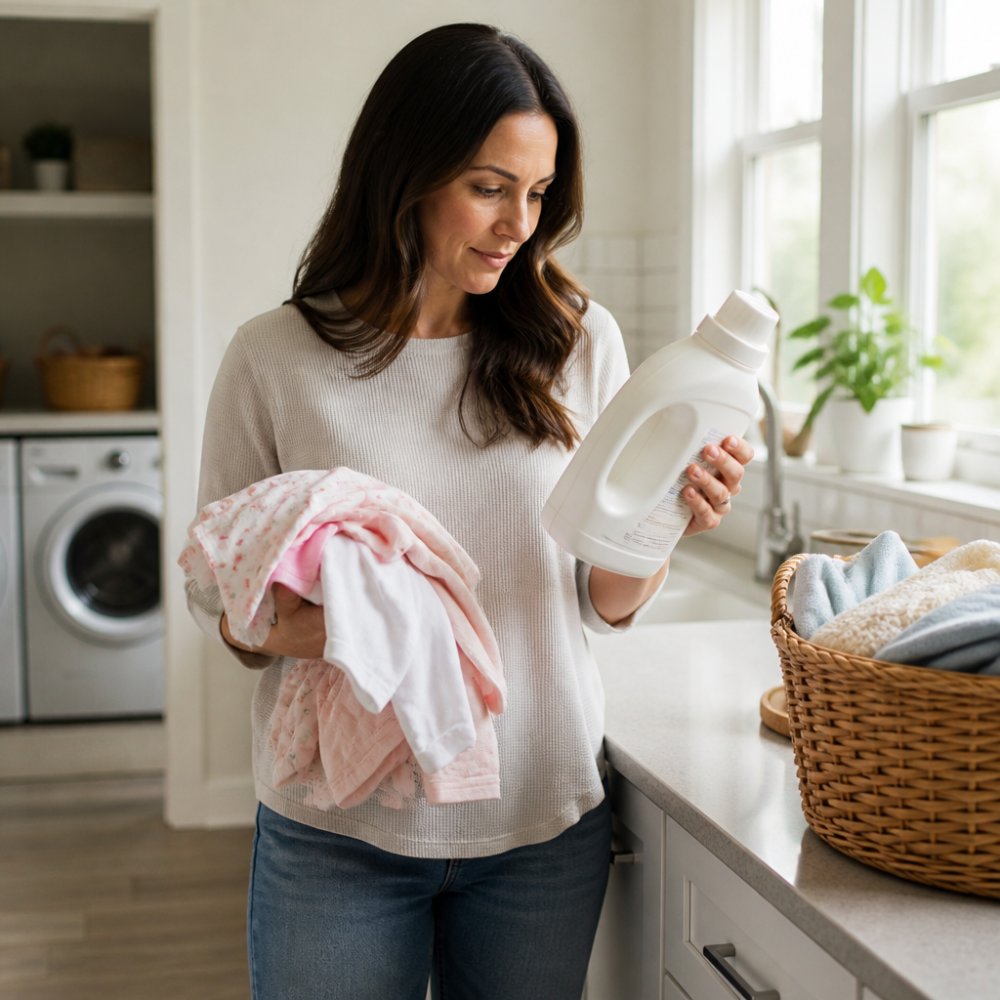
Synthetic fragrances and perfumes are the most common cause of contact dermatitis from laundry products.
This is where "unscented" and "fragrance-free" diverge. Unscented products often contain masking fragrances that neutralize other smells while still depositing fragrance chemicals on fabric.
Optical brighteners are fluorescent compounds that absorb ultraviolet light and re-emit it as visible blue light, making fabric look whiter.
Sulfates such as sodium lauryl sulfate (SLS) and sodium laureth sulfate (SLES) are effective surfactants, but the same oil-stripping mechanism that cleans fabric strips natural oils from skin. For children with eczema or sensitive skin, sulfate-heavy detergent can leave skin dry and irritated within hours of wearing.
Dyes and colorants serve no cleaning purpose, existing only so the detergent looks appealing in the bottle.
Preservatives and stabilizers such as methylisothiazolinone (MIT) and parabens extend shelf life and prevent microbial growth, but they are well-documented contact allergens.
Phosphates are less common today but still appear in some formulas. They soften water and boost cleaning, but they are environmental pollutants that can irritate sensitive skin.
How to Remove Detergent Residue from Clothes
Detergent residue accumulates invisibly with each wash, even with gentle formulas, and over time can trigger reactions in children with sensitive skin. Removing existing residue is essential when switching to a new detergent.
Strip-washing is the most effective method. Fill a bathtub or large container with hot water (as hot as the fabric can tolerate). Submerge the clothing and let it soak for 4-6 hours, stirring occasionally. The detergent residue will release into the water. Drain and repeat if the water still looks cloudy, then wash normally with your new fragrance-free detergent.
For heavy residue, add a small amount of white vinegar to the soak water to help break down mineral deposits.
Free & Clean Laundry Detergent →
After switching to a gentler detergent, use an extra rinse cycle for the first two weeks to prevent new residue buildup and give your child's skin time to recover.
Reducing detergent amount also helps, since plant-based or concentrated formulas need less. Dosing properly for load size and water hardness prevents excess residue from accumulating.
Liquid, Powder, and Pod Formats: Which Works Best for Sensitive Skin
The format you choose affects how well detergent dissolves, rinses away, and potentially irritates skin. The right choice depends on your washer, water, and how precisely you want to control dosing.
Liquid detergents dissolve completely in hot and cold water and rinse more thoroughly than powders.
Powder detergents can leave residue if water is cold or the load is too large, and undissolved particles sit on fabric and irritate skin directly.
Detergent pods are convenient but problematic for sensitive skin. The coating doesn't always dissolve completely, especially in cold water, short cycles, or large loads, and residual coating can remain on clothing and trigger irritation.
Dosing accuracy matters as much as format. Too much detergent, even a gentle one, leaves residue that can irritate skin, and overpouring concentrated formulas is a common mistake.
Water hardness affects how each format performs. Hard water minerals bind with detergent and reduce cleaning power, leading to more product and more residue.
For sensitive skin clothing, liquid detergent in the correct dose is the most reliable format: it dissolves completely, rinses thoroughly, and gives precise control over how much detergent contacts your child's skin.
| Format | Dissolution | Dosing Control | Residue Risk | Best For |
|---|---|---|---|---|
| Liquid | Complete in hot or cold | High | Low | Sensitive skin, HE washers, precise dosing |
| Powder | Requires warm/hot water | Moderate | Moderate to high | Budget-focused households willing to use warm water and extra rinses |
| Pods | Variable, cold water risk | Low | Moderate | Convenience-focused users without sensitive skin concerns |
Practical Tips for Washing Sensitive Skin Clothing
Beyond choosing the right detergent, your washing routine affects how well clothes work for sensitive skin.
Water temperature matters. Warm or hot water helps detergent dissolve and rinse thoroughly, while cold water can leave residue, especially with powder or pods. Use warm water whenever the fabric allows.
Load size affects residue. Overloading means less water per garment and incomplete rinsing. Wash sensitive skin clothing in smaller loads so detergent rinses away completely.
Extra rinse cycles are your friend. An additional rinse after the main wash removes residual detergent. For children with severe sensitivity, two extra rinse cycles are worth the water use.
Water hardness changes how detergent works. Hard water reduces effectiveness and increases residue.
Fabric care extends the life of sensitive skin clothing. Wash inside-out to reduce pilling and fading. Avoid fabric softener and dryer sheets, they add coating that traps detergent residue.
Separate sensitive skin clothing from heavily soiled items. Washing delicate items apart from work clothes or sports wear lets you use gentler cycles and lower temperatures without compromising cleanliness.
| Washing Factor | Best Practice for Sensitive Skin | Why It Matters |
|---|---|---|
| Water temperature | Warm or hot | Helps detergent dissolve and rinse completely |
| Load size | Smaller loads | Ensures thorough rinsing and less residue |
| Rinse cycles | Extra rinse (2 total) | Removes residual detergent buildup |
| Water hardness | Test and adjust dosing | Hard water increases residue risk |
| Fabric softener | Avoid completely | Traps detergent and irritants on fabric |
| Drying method | Air-dry when possible | Preserves fabric and reduces heat damage |
Choosing the right laundry detergent for sensitive skin is an investment in your child's comfort. At Doodlebug's Children's Boutique, we recommend Zoey Naturals Free & Clean Laundry Detergent because it's formulated with plant-based ingredients, free from dyes and fragrances, and designed for children's sensitive skin.
American Academy of Dermatology guidance on sensitive skin care
National Eczema Association recommendations for laundry and clothing
Consumer Product Safety Commission guidelines on detergent ingredients
Frequently Asked Questions
What ingredients in laundry detergent commonly irritate sensitive skin?
Synthetic fragrances, optical brighteners, dyes, sulfates, and certain enzymes are the primary irritants for reactive skin. Synthetic fragrances and dyes are added purely for appearance or scent, they don't clean clothes and frequently trigger skin reactions. Sulfates strip natural oils from skin and fabric. Optical brighteners create a whitening effect but can accumulate on clothing and cause irritation. For children with sensitive skin or eczema, fragrance-free and dye-free formulas eliminate these common irritants entirely.
Is fragrance-free laundry detergent better for sensitive skin?
Yes. Synthetic fragrances are among the most common irritants in laundry detergent. Even 'gentle' or 'mild' fragrances can trigger reactions in people with reactive skin, eczema, or sensory sensitivities. Fragrance-free formulas remove this irritant entirely. Some detergents labeled 'unscented' still contain masking fragrances to hide chemical odors, so look specifically for 'fragrance-free' on the label. Plant-based ingredients and biodegradable formulas often pair well with fragrance-free designs for maximum skin safety.
Can laundry detergent residue irritate skin?
Absolutely. Detergent residue left on clothing after rinsing is a major source of skin irritation. Residue builds up over multiple washes and traps bacteria and sweat against the skin. Children with sensitive skin are especially prone to reactions from buildup. Using the correct detergent dosage, running an extra rinse cycle, and choosing low-residue or highly rinse-able formulas all reduce this risk. Hypoallergenic, plant-based detergents typically rinse out more completely than conventional options, lowering irritation risk.
Should you use liquid or powder detergent for sensitive skin?
Liquid detergent is generally better for sensitive skin because it dissolves completely and rinses out more thoroughly, leaving less residue on clothing. Powder detergent can leave particles trapped in fabric fibers, especially in cold water, which increases irritation risk. Pods dissolve quickly but can concentrate detergent in one spot if not fully dissolved. For children with reactive skin, liquid fragrance-free, dye-free formulas offer the best combination of complete rinsing and ingredient safety. Always use the recommended dosage to avoid residue buildup.
