
Table of Contents
- Tagless Shirts vs Regular Shirts: What's the Real Difference
- Best Fabrics for Sensitive Skin
- Beyond the Tag: Other Sources of Shirt Irritation
- Tagless Shirts for Kids: Finding the Right Fit
- How to Remove Clothing Tags Without Damaging a Shirt
- Care and Washing Tips to Reduce Irritation
- Frequently Asked Questions
Last Updated: October 17, 2026
Tagless Shirts vs Regular Shirts: What's the Real Difference
When your child won't stop tugging at their neck, the problem often isn't the fabric, it's what's attached to it.
The core difference: tagless shirts have printed labels directly on the fabric instead of sewn-in tags stitched into seams. But "tagless" covers at least four label constructions, each with a different irritation profile.
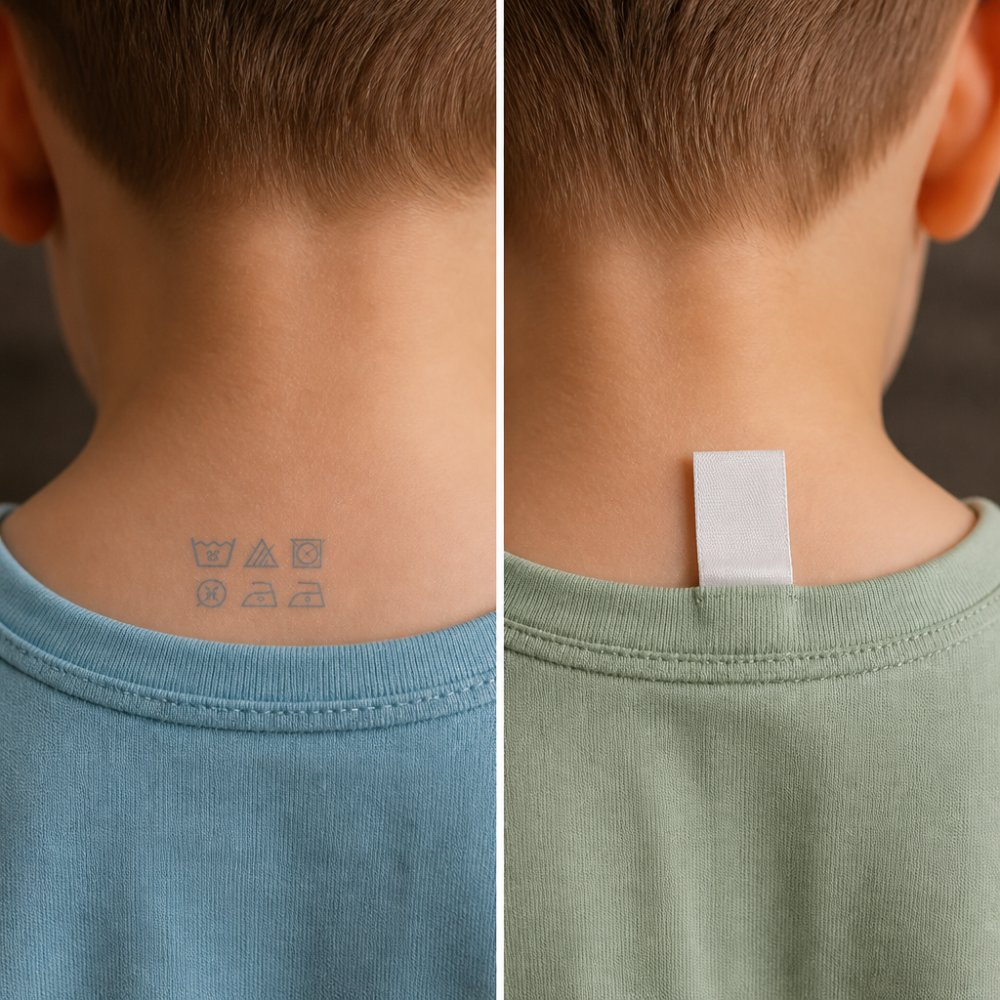
The Four Tagless Label Designs and Their Trade-Offs
Manufacturers use four distinct tagless approaches, and the differences matter for sensitive skin.
Printed labels (screen-printed or digital). Ink is applied directly to the inside of the garment, usually at the back neck.
Heat-transfer labels. A printed film is bonded to the fabric with heat and pressure.
Tear-away tags. These are sewn-in tags made from perforated or loosely woven material designed to be torn out cleanly.
How Printed Labels Compare to Sewn-In Tags
Printed labels sit flat against the fabric and don't create the rigid, scratchy edge that sewn-in tags produce. A traditional tag is stitched into the seam, so it can shift, bunch, or rub directly against sensitive skin, and its cut edge can fray into stiff fibers after a few washes.
But printed labels have their own trade-off: the ink itself can irritate some children, particularly those sensitive to dyes or chemical finishes. Unless the brand specifies water-based versus petroleum-based inks, you won't know which you're getting.
The Comfort Trade-Offs of Each Design
Tagless shirts offer immediate relief for tag-related irritation and are easier to care for, no tag to come loose or fray. Many parents report their children will wear tagless options when they refuse regular shirts entirely. Regular shirts with traditional tags offer a clear visual marker of size and care instructions, and the tags are more durable through washing. But for children with sensory processing disorders or autism, that advantage means nothing if the shirt stays in the drawer unworn.
Best Fabrics for Sensitive Skin
The fabric itself matters as much as the label design. Even a perfectly tagless shirt won't work if the material causes friction, traps heat, or contains irritating dyes.
Cotton and Organic Cotton
Cotton is the most common choice for sensitive skin because it's breathable and soft when treated properly. Organic cotton is grown without synthetic pesticides or fertilizers, so fewer chemical residues can irritate skin. The catch: not all cotton is equally soft, thread count, fiber length, and processing determine how the fabric feels. Organic costs more, and conventional cotton properly softened through washing may work just as well; the organic difference matters most if your child reacts specifically to pesticide residues, which is less common than general tactile sensitivity.
Bamboo Fabric: Breathability and Moisture Management
Bamboo viscose has gained popularity in sensory-friendly clothing for good reason. It's naturally breathable, moisture-wicking, and exceptionally soft straight from manufacturing. Many parents find their children tolerate bamboo better than cotton because it doesn't trap heat or sweat, reducing a major trigger for kids who experience sensory overload from temperature fluctuations. The Fiji Tank Top at Doodlebug's Children's Boutique demonstrates this approach, made from 95% bamboo viscose with 5% spandex for stretch, it's tagless and designed specifically for sensitive skin.
Natural vs Synthetic Materials
Natural fibers (cotton, bamboo, linen) generally work better for sensitive skin than synthetics like polyester or nylon. They breathe better, absorb moisture instead of trapping it, and typically contain fewer chemical finishes. Synthetic blends are chosen for durability and wrinkle resistance, not comfort, they can trap heat, promote sweating, and cause friction-related irritation. A small percentage of spandex blended with natural fibers is usually well-tolerated: 85% cotton and 15% spandex is usually fine; 60% polyester and 40% cotton makes sensitivity issues more likely.
Beyond the Tag: Other Sources of Shirt Irritation
Here's where many parents hit a wall: they buy tagless shirts, and their child still complains. The tag wasn't the only problem.
Seams, Elastic, and Construction Details
Seams are a major irritation source that tagless design doesn't address. Rough seams, particularly around the neckline and armholes, can cause as much discomfort as a traditional tag. Some manufacturers use flat-lock seams (softer and flatter); others use standard stitching that creates a raised ridge. Elastic in the waistband, sleeve cuffs, or neckline can also trigger sensory responses, tight elastic restricts movement and creates constant pressure, while loose elastic bunches.
Ocean Blue Unisex Bamboo Short Sleeve Tee Shirt →
Dyes, Finishes, and Chemical Sensitivity
The dyes used to color fabric can irritate sensitive skin, particularly if they're not fully set during manufacturing. Darker colors sometimes require more dye and chemical processing, increasing irritation risk. Chemical finishes applied after dyeing, softeners, water repellents, wrinkle-resistance treatments, can also cause reactions. Washing new shirts before wearing removes excess dyes and loose chemical residues; wash inside-out with mild detergent and skip fabric softener to reduce irritation further.
Tagless Shirts for Kids: Finding the Right Fit
Tagless design specifically benefits children with sensory processing differences, autism, or tactile defensiveness. The Ocean Blue Unisex Bamboo Short Sleeve Tee Shirt ($36.99) is tagless, made from 95% bamboo viscose with 5% Lycra, and designed with a relaxed fit that doesn't restrict movement; the fabric is breathable and moisture-wicking, addressing heat sensitivity that often accompanies sensory issues. For older kids who resist anything that looks babyish, the Navy Blue Bamboo Unisex Short Sleeve Shirt ($36.99) and Tropical Green Unisex Bamboo Long Sleeve Shirt ($37.99) provide comfort without sacrificing style that an 10 or 11-year-old would actually wear.


How to Remove Clothing Tags Without Damaging a Shirt
If your child already owns regular shirts they like but the tag bothers them, careful removal is an option, best for sewn-in tags where you can access the stitching. Use small, sharp scissors or a seam ripper to cut the stitches holding the tag to the fabric, working slowly and keeping the blade close to the tag, not the shirt fabric.
Care and Washing Tips to Reduce Irritation
How you wash clothing affects how it feels on sensitive skin. Even the best tagless bamboo shirt becomes uncomfortable if washing damages the fabric or leaves chemical residue. Care is also where parents can do the most useful troubleshooting: a shirt that irritates on day one may be fine after the right wash, and one that was fine for months can start irritating after a detergent change or a hot dryer cycle.
A Simple Test to Identify What's Actually Irritating
Before you blame the tag, run a short, structured test. It won't replace a doctor's advice, but it will help you narrow the trigger.
- Baseline the shirt. Put the shirt on your child inside-out for 10-15 minutes with no other new clothing or lotion. Note where they tug, scratch, or complain. Inside-out wear isolates the skin-contact surface from the outside print or dye.
- Isolate the label. If the complaint is at the back neck, fold a soft, fragrance-free cloth over the label area and repeat. If the fussing stops, the label is a likely trigger. If it continues, look at seams, fit, or fabric.
- Isolate the seams. Turn the shirt right-side out and check the neckline, armholes, and side seams by running the back of your fingernail along them. A seam that catches your nail is a seam that can catch skin. Flat-lock seams feel smooth; standard overlock seams feel like a raised ridge.
- Isolate the wash. Wash the shirt once with a fragrance-free, dye-free detergent and no fabric softener, then repeat the inside-out test. If comfort improves, residue was part of the problem. If nothing changes, the issue is more likely construction or fit.
- Isolate the fit. Try one size up, or a relaxed cut, and repeat. Pressure from a snug neckline or cuff can mimic tag irritation, especially in children who are sensitive to compression.
Reducing Detergent and Chemical Residue
Residue is the most under-discussed irritant in sensitive-skin clothing. Detergents, softeners, and dryer sheets leave a film on fibers that can trap heat, reduce breathability, and sit directly against skin. A few adjustments make a measurable difference:
- Choose a fragrance-free, dye-free detergent. Fragrance is one of the most common contact irritants in laundry products, and "free and clear" formulas are widely available.
- Use less than the cap suggests. Most detergents are dosed for heavily soiled adult laundry; for children's shirts washed frequently, half a cap is often enough.
- Skip fabric softener and dryer sheets entirely. Both coat fibers with a waxy or silicone film, the opposite of what breathable, skin-friendly fabric needs.
Washing and Drying by Fabric
Different fabrics tolerate different care, and the wrong cycle can change how a shirt feels against skin.
| Washing Step | Recommendation | Why It Matters |
|---|---|---|
| Water temperature | Cold for bamboo and blends; warm is acceptable for sturdy cotton | Hot water can set dyes and shrink or roughen bamboo viscose |
| Detergent type | Mild, fragrance-free, dye-free | Heavy or perfumed detergents leave residue that can irritate skin |
| Fabric softener | Skip entirely | Adds a chemical coating that reduces breathability |
| Wash direction | Inside-out for printed labels and bamboo | Protects the label print and reduces pilling on smooth fibers |
| Drying method | Low heat or air-dry; avoid high heat | High heat can stiffen fibers and accelerate label peeling |
| New shirt prep | Wash before wearing, with an extra rinse | Removes sizing, excess dye, and manufacturing residue |
For bamboo specifically, wash inside-out with other bamboo items to prevent color transfer and pilling, and use color-catcher sheets to trap loose dyes. Tumble dry on low heat or lay flat to air-dry. Washing inside-out also protects printed labels from fading faster than the rest of the garment, keeping the label from becoming rough or peeling as it ages.
When to Stop Troubleshooting and Ask a Professional
Most shirt-related discomfort is friction, fit, or residue, and it improves with the changes above. But some patterns deserve a medical conversation rather than another shopping trip. Check with a pediatrician or dermatologist if:
- A rash persists for more than a week despite switching to soft, tagless, fragrance-free-washed shirts.
- The reaction appears within hours of wearing a specific garment and recurs every time, suggesting a contact allergy rather than simple friction.
- You see weeping, blistering, or spreading redness, or the child develops a fever.
A clinician can distinguish ordinary irritation from suspected contact dermatitis and identify specific triggers. Care guidance in this article is general and is not a substitute for individual medical advice.
Frequently Asked Questions
Are tagless shirts actually better for sensitive skin?
Tagless shirts eliminate one source of irritation: the neck label. However, they're not a complete solution. Children with sensitive skin can still experience discomfort from rough seams, elastic bands, synthetic dyes, or fabric texture. The benefit of tagless design is real but limited to that one irritant. Pairing a tagless shirt with soft, breathable fabric like bamboo or organic cotton makes a much bigger difference than the label type alone.
What are the best fabrics for sensitive skin?
Bamboo viscose and organic cotton are the top choices. Bamboo is naturally breathable, moisture-wicking, and hypoallergenic, making it ideal for heat regulation and reducing skin contact irritation. Organic cotton avoids harsh pesticide residues and chemical finishes. Both fabrics are softer than conventional synthetic blends and allow skin to breathe. Avoid polyester and synthetic materials if possible, as they trap heat and moisture, which can trigger itching and discomfort in sensitive skin.
Can a shirt still irritate sensitive skin even without a neck tag?
Yes. Seams, especially flat-lock or reinforced seams, can cause friction and irritation. Elastic in waistbands and sleeves, rough fabric texture, chemical dyes, and fabric finishes are common culprits. Some children react to the stiffness of new clothing or residual detergent. Testing a shirt on your child's skin before committing to multiple purchases, and washing new items in fragrance-free detergent before wear, can help identify problem areas beyond just the tag.
How do I remove a clothing tag without damaging the shirt?
Use small, sharp scissors or seam rippers to carefully cut the threads holding the tag to the fabric. Cut as close to the tag as possible, not the shirt itself. For printed labels, no removal is needed. If you're concerned about leftover thread holes, trim any loose threads with nail scissors and gently rub the area with your fingers to relax the fabric. Wash the shirt afterward to soften any remaining stiffness from the removal process.