
Table of Contents
- What Makes Clothing Sensory Friendly?
- The Best Fabrics for Sensory Processing Disorder
- Step 1: Check the Seams and Stitching
- Step 2: Evaluate the Fit and Fasteners
- Step 3: Look for Tagless Pajamas for Sensitive Skin
- DIY Modifications for Everyday Clothes
- Your Sensory Friendly Clothing Checklist
- Conclusion: Trust What Your Child Feels
- Frequently Asked Questions
Last Updated: September 5, 2026
Finding clothes that don't cause daily battles is one of the most practical ways to reduce sensory overload for a child. Sensory friendly clothing minimizes tactile triggers like scratchy seams, stiff fabrics, and irritating tags. At Doodlebug's Children's Boutique, we help parents move past the guesswork by focusing on the construction details that make an outfit wearable for a child with tactile sensitivity. You don't need a degree in textile science to spot the right pieces; you just need to know what to look for and what to avoid.
Most parents start by searching for softer materials, but the real difference often lies in how the garment is put together. Below, we walk through the exact steps we use to evaluate clothing, from checking interior seams to understanding which fabrics support emotional regulation best.
What Makes Clothing Sensory Friendly?
Sensory friendly clothing reduces or eliminates tactile triggers that cause distress for individuals with sensory processing disorder or autism, helping a child stay regulated so they can focus on playing, learning, and sleeping rather than fighting their clothes.
The design philosophy removes friction points: tagless construction, flat-lock seams, and smooth fabrics. For many children, the problem is the combination of stiff denim, a rough label, and a bulky zipper pressing at once. Removing those competing sensations reduces sensory load and supports self-regulation.
Clothing that works well is also forgiving in fit. Tight waistbands or restrictive armholes create constant low-level pressure some children find unbearable. Look for pieces with stretch and a silhouette that doesn't fight natural movement.
The Best Fabrics for Sensory Processing Disorder
The best fabrics for sensory processing disorder are soft, breathable, and moisture-wicking, with bamboo and organic cotton ranking at the top. But these fibers work only if they hold up after repeated washing.
Bamboo viscose is a standout because it is extruded as a continuous filament, so the yarn has no loose ends to poke through the weave, giving it a buttery, silky texture children tolerate well. It also drapes loosely without clinging. Look for 100% bamboo viscose or a blend with at least 5% spandex; anything less than 90% bamboo loses the drape.
Organic cotton is reliable only when combed or ringspun, which removes shorter, stiffer fibers. Test it by rubbing the fabric against your inner wrist; if it feels smooth there, it will likely feel smooth on the torso. If it feels rough, skip it, roughness only amplifies after washing.
What about the laundry factor? Standard detergents stiffen natural fibers, and fabric softeners coat bamboo with a waxy layer that traps heat. Wash in fragrance-free liquid detergent, skip fabric softener, and tumble dry on low or hang dry. If using a dryer sheet, use an unscented, hypoallergenic one only on the outside of the garment.
Fabrics to avoid include wool (unless labeled merino or superwash) and synthetic blends like polyester or acrylic that don't breathe. These feel prickly or trap heat and moisture. A child may tolerate a polyester blend in the store but melt down within an hour because it doesn't wick sweat, leading to a clammy sensation.
A note on aging fabrics: Bamboo and cotton soften with washing, but only with the right detergent. Harsh enzymes in stain removers can break down fibers, causing pilling. Turn pilling shirts inside out before washing to protect the smooth interior, and use a fabric shaver (under $15) to restore the surface.
Step 1: Check the Seams and Stitching
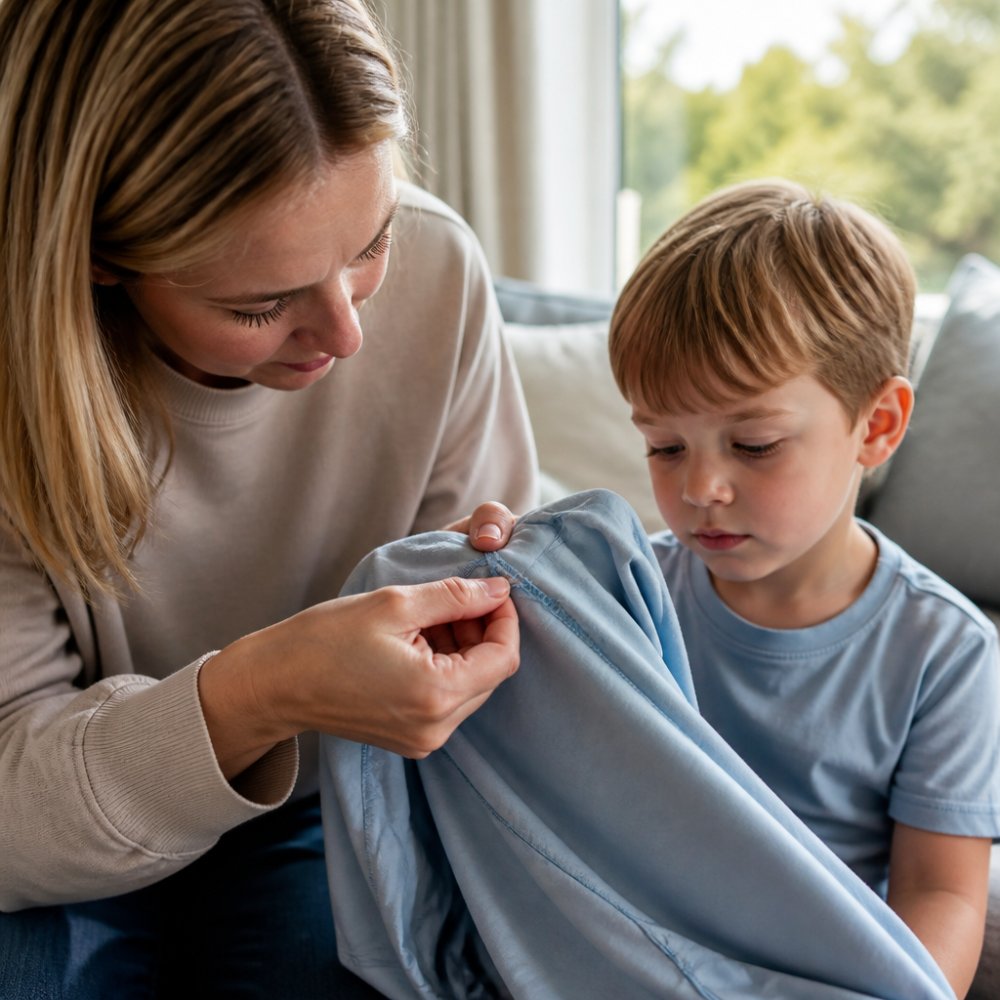
Turn the garment inside out and run your fingers along every interior seam, the most reliable way to identify sensory friendly clothing, since seams are the most common source of irritation after tags.
Standard overlock seams leave a raised ridge that rubs with every movement. Look for flat-lock seams, which lie flush and eliminate that ridge. Also check the hem at the bottom of shirts and pants, which constantly brushes the hips and thighs.
A rough seam is not necessarily a lost cause, some brands finish seams with soft binding or fold fabric to hide the edge. The key is that the interior feels as smooth as the exterior.
Step 2: Evaluate the Fit and Fasteners
A garment can be made of the softest bamboo and still fail if the fit or fasteners cause problems. The right fit is neither too tight nor so loose that fabric shifts and bunches. Adults face a unique challenge: most professional clothing has stiff collars, structured waistbands, and hardware that digs in. Here's how to evaluate fit and fasteners for both.
For children: Start with the waistband. Elastic waistbands distribute pressure evenly, but ensure the elastic is soft and fully encased, an exposed or stiff edge can dig into the belly. For older kids needing belts or buttoned pants, choose flat-front styles at the natural waist. A common trick is to buy pants one size up and use a soft, wide elastic belt that cinches without pressure.
For adults: The professional wardrobe is hardest to adapt. Look for "soft-structured" garments, dress pants with a flat front but no internal stiffening, and blazers with no shoulder pads. For dress shirts, choose a "hidden placket" that covers buttons inside, preventing pressure on the chest. For women, avoid underwire bras; for men, avoid stiff collar stays and look for a "soft collar."
Fasteners are a frequent trigger for meltdowns, for both kids and adults. Zippers pinch, snaps feel cold, and buttons require fine motor skills hard to manage in frustration. For younger children, magnetic closures or pull-on styles are ideal. For tweens, look for pants with a faux fly and functional elastic waistband for a mature look without hardware.
For adults, the fastener problem is more subtle. Metal buttons on dress pants press into the belly when sitting. Replace them with flat, smooth plastic ones (under $2 at craft stores) or add a soft fabric patch behind the button. For dress shoes, elastic laces (around $8) provide slip-on convenience without visual compromise.
Footwear and accessories are an underserved part of the sensory conversation. Look for seamless toe socks (Bombas and Smartwool make them) to eliminate the ridge across toes. For shoes, avoid stiff heel counters and choose wide-toe-box styles. Velcro is ideal for children; for adults, bungee or elastic lacing provides a secure fit without knot pressure.
A practical test for any garment: Put it on and sit for 10 minutes, then stand, reach, and twist. If any single point of pressure doesn't shift or release, the garment won't work for a full day. The best sensory-friendly clothing is the kind you forget you're wearing.
Step 3: Look for Tagless Pajamas for Sensitive Skin
Tagless pajamas for sensitive skin are non-negotiable for a restful night, since sleep is when a child lets their guard down and the smallest irritation becomes unbearable. A scratchy tag or rough seam can delay sleep onset and cause frequent night wakings.
The ideal sleepwear uses the same principles as daytime clothing but with an even higher standard for softness. Bamboo pajama sets, like the Kickee Pants Falcon Snow Long Sleeve Bamboo Pajama Set from Doodlebug's, are printed directly onto fabric rather than using a woven-in label, removing the tag entirely while keeping playful prints.

Check cuffs and ankle openings too. A snug fit is good for warmth, but elastic should be soft and not leave red marks. If your child sleeps hot, choose moisture-wicking bamboo blends that pull sweat away rather than trapping it.
DIY Modifications for Everyday Clothes
If you cannot replace an entire wardrobe at once, small modifications can make a huge difference. These budget-friendly fixes can turn a problem garment into a wearable one.
The first fix is removing tags. Use a seam ripper to unpick the stitches, then check for remaining fibers. If the tag is printed on fabric, soften it with fabric softener or a dryer sheet.
For rough seams, apply a thin strip of soft cotton ribbon or bias tape over the interior seam with fabric glue to create a barrier. For scratchy waistbands, sew a soft cotton panel inside the band or wear seamless shorts underneath as a base layer.
Your Sensory Friendly Clothing Checklist
Use this checklist when shopping, whether online or in a store, to quickly evaluate whether a garment will work for your child.
- Fabric is at least 90% bamboo, organic cotton, or another soft natural fiber
- Fabric is breathable and moisture-wicking, not heavy or stiff
- Turned inside out, all seams feel flat and smooth against the skin
- No tags, or tags are printed directly onto the fabric
- Waistband is soft, fully encased elastic that does not dig in
- No rough zippers, snaps, or buttons that press against the body
- Fit is relaxed but not baggy, allowing free movement without bunching
- Cuffs and necklines are soft and do not leave marks
| Feature | What to Look For | What to Avoid |
|---|---|---|
| Fabric | Bamboo, organic cotton, breathable | Wool, stiff denim, synthetic blends |
| Seams | Flat-lock, smooth interior | Overlock, raised ridges |
| Tags | Tagless or printed | Woven labels, plastic tags |
| Waistband | Soft encased elastic | Stiff elastic, tight drawstrings |
| Fasteners | Magnetic, pull-on, no hardware | Zippers, metal snaps, buttons |
Conclusion: Trust What Your Child Feels
The most important tool for identifying sensory friendly clothing is your child's own reaction. No checklist or fabric guide replaces the simple test of whether a garment causes distress within the first few minutes of wear.
At Doodlebug's Children's Boutique, we curate our collection around these exact principles, offering bamboo and organic options that are tagless, breathable, and designed to grow with your child. If you are looking for a place to start, explore our range of sensory-friendly bamboo pants or consider our pajama subscription to discover what works without the risk of buying multiple failed items.


Get started with Doodlebug's Children's Boutique and find sleepwear and daywear that your child will actually want to wear.
Frequently Asked Questions
What specific features make clothing sensory-friendly?
Sensory friendly clothing typically has tagless labels or no tags at all, flat seams that don't rub the skin, and soft, stretchy fabrics like bamboo or organic cotton. The fit should be snug but not restrictive, without scratchy zippers, snaps, or rough elastic. Many styles also use covered waistbands and cuffs to prevent irritation.
Why is tagless clothing important for sensory processing?
For children with tactile sensitivity, a scratchy tag can feel like a constant irritation that triggers meltdowns and makes it hard to focus. Tagless clothing removes this common clothing trigger, allowing kids to wear their clothes without the distraction of a persistent scratchy texture against their neck or back.
How do fabric textures impact children with sensory sensitivities?
Fabric texture is often the first thing a sensory-avoiding child notices. Rough, scratchy textures like wool or some synthetic materials can cause immediate discomfort and distress. On the other hand, smooth, soft, and breathable natural fibers like bamboo or combed cotton provide a calming sensation and help children avoid sensory overload.
How can I transition my child to sensory friendly clothing without a fight?
Start by introducing one or two new items, like a pair of tagless bamboo pants or a soft pajama set, without removing their current favorites. Let your child touch and feel the new fabric first. Gradually swap out the most irritating items, like socks or pajamas, and praise them for trying something new.
This article was written using GrandRanker