
Table of Contents
- Why Tagless Organic Cotton Pajamas Matter for Sensory-Sensitive Children
- How to Choose Pajamas for Sensory-Sensitive Children
- Organic Cotton Pajamas for Kids: Verifying Certifications
- Seamless Pajamas for Children: Construction Details That Matter
- Bamboo Pajamas for Sensitive Skin: Comparing Natural Fibers
- Your Step-by-Step Buying Checklist
- Care and Durability: Keeping Tagless Pajamas Soft
- Frequently Asked Questions
Last Updated: October 15, 2026
Why Tagless Organic Cotton Pajamas Matter for Sensory-Sensitive Children
When your child tears off their pajamas at bedtime or complains about tags scratching their neck, you're seeing sensory sensitivity in action. Tagless organic cotton pajamas eliminate one of the most common irritants keeping sensory-sensitive children awake.
The difference goes beyond comfort. Children with sensory processing disorders, autism, or sensitive skin react to textures other kids don't notice. A tag rubbing the neck or seams pressing into skin can trigger meltdowns and restless sleep.
This guide shows how to identify genuinely tagless pajamas, verify organic certifications, and choose styles that work for your child's sensory needs.
How to Choose Pajamas for Sensory-Sensitive Children
"Look for tagless" fails at purchase, because "tagless" is a marketing term, not a regulated one. Here is a repeatable process for verifying construction, seams, closures, and fabric before you buy.
Step 1: Verify True Tagless Construction (Not Just "Tagless" Marketing)
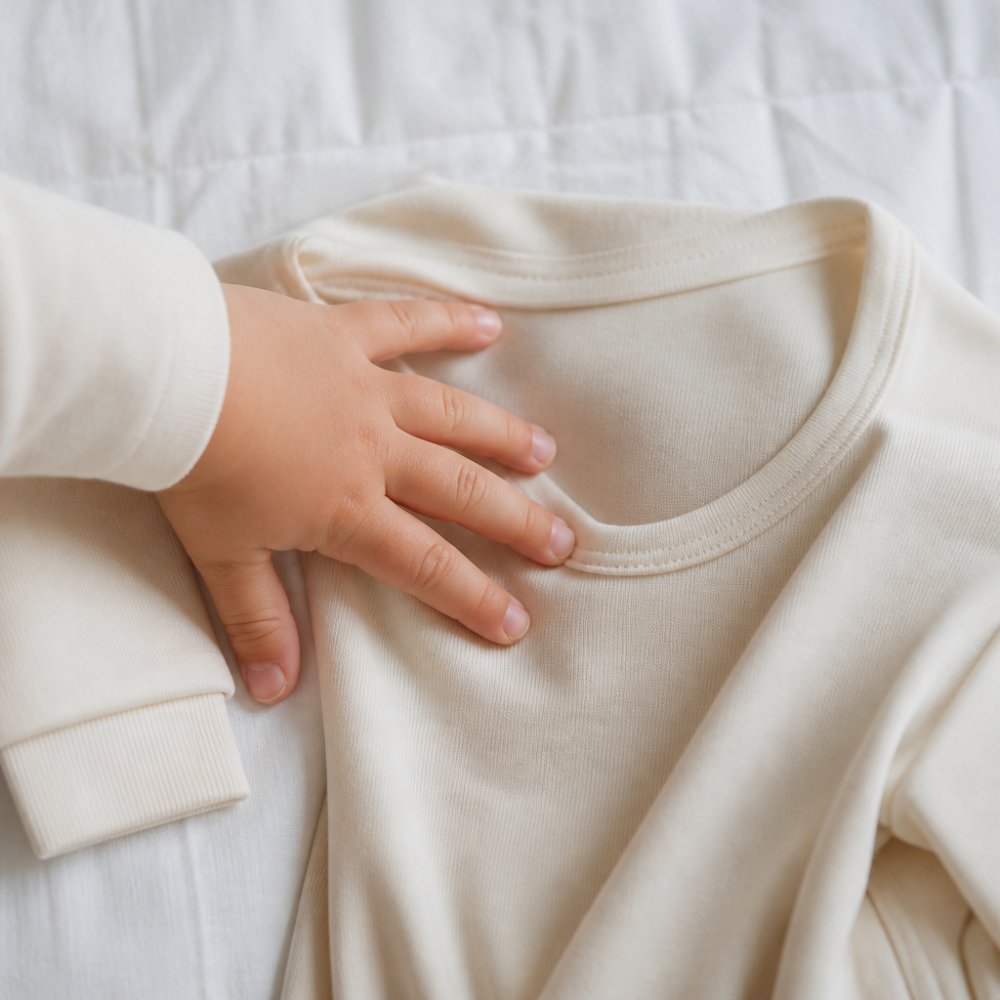
True tagless construction means the label is printed directly onto the fabric, or the garment has no interior label at all. It does not mean a woven tag folded under a seam, many brands use "tagless" for that, and your child still feels the bulk against the neck.
Here is how to test a pair in under a minute:
- Turn the neckline inside out. Run your thumb along the back neck seam. Genuine tagless feels like one continuous surface; a folded tag feels like a raised ridge or pencil-eraser-sized lump.
- Press a finger into the tag zone. Printed labels have almost no thickness; folded tags compress and spring back.
- Check for a second label. Some garments print the size on the neck but sew a care tag into the side seam, a common trigger parents miss.
- Look at the ink. Printed labels should be soft, not plasticky or raised. Heat-transfer labels that feel like a decal can crack and stiffen after washing.
Step 2: Evaluate Seams, Closures, and Hardware
Seams are the second-most-common sensory trigger after tags, and harder to fix because you cannot remove them.
- Flatlock seams join two fabric edges without a raised fold and lie nearly flush against skin, the standard for sensory-friendly sleepwear.
- Standard inseams create a ridge that presses into the underarm, inner thigh, and torso, and are most likely to cause complaints.
- Outward-facing seams put the bulk on the outside, leaving the interior smooth.
To check: turn the pajamas inside out and run your finger along the underarm, inner thigh, and side seams. A ridge taller than a grain of rice will likely trigger a highly sensitive child.
Closures matter too. Zippers add teeth and a pull tab that can dig in during sleep; snaps and buttons create hard points. Magnetic closures can interfere with medical devices, so check with your child's care team first.
Step 3: Match Fabric Weight and Fiber to Your Child's Sensitivity Profile
Fabric choice depends on whether your child's primary trigger is texture, temperature, or both.
| Sensitivity profile | Best fabric match | Why |
|---|---|---|
| Reacts to texture, tolerates warmth | Medium-weight 100% organic cotton | Smooth, predictable hand feel; holds shape through washes |
| Overheats easily, reacts to heavy fabric | Lightweight muslin or double gauze | Open weave breathes; less fabric mass against skin |
| Eczema or extreme tactile sensitivity | Bamboo viscose or bamboo-cotton blend | Very smooth surface; less friction on irritated skin |
| Needs stretch for movement or dressing | Organic cotton with a small spandex percentage | Stretch reduces pull and tug during dressing |
A small amount of spandex (3-5%) improves fit and reduces pulling, but if your child reacts to synthetic fibers, stick with 100% organic cotton even if the fit is looser.
Step 4: Confirm Fit and Sizing Before You Buy
Sensory-sensitive children often do better in a looser fit, but "looser" has limits: too long bunches at the ankles, too tight creates pressure points at the waist and shoulders.
Check the size chart against your child's actual measurements, not their age-based size. Watch inseam length (too long bunches, too short rides up), sleeve length (mid-forearm cuffs feel restrictive), and waistband width (wider, softer bands distribute pressure better).
Step 5: Test One Pair Before Committing
Buy one pair in the style you're considering and have your child wear it one full night before washing, so you can still return it if the construction triggers a reaction. If it works, order multiples. This single-pair test is the most reliable way to avoid five sets your child refuses to wear.
Organic Cotton Pajamas for Kids: Verifying Certifications
"Organic cotton" is one of the most abused phrases in children's sleepwear. The term isn't legally restricted for U.S. textiles the way "organic" is for food, so any brand can print it on a hangtag. The only way to know what you're buying is to verify the certification behind the claim.
What GOTS Actually Certifies
The Global Organic Textile Standard (GOTS) is the most widely recognized certification for organic textiles, covering the entire supply chain:
- Fiber: at least 70% certified organic fibers for "made with organic," at least 95% for "organic"
- Processing: restrictions on dyes, bleaches, and chemical inputs, including a ban on formaldehyde and heavy metals
- Social criteria: labor standards covering hours, wages, and safe conditions
For parents of sensory-sensitive children, the processing restrictions matter most: a GOTS-certified garment has been screened for the chemical residues most likely to irritate reactive skin.
How to Verify a GOTS Claim (Step by Step)
A brand saying "GOTS certified" is not proof. To confirm it:
- Look for the GOTS logo on the product or packaging. The logo includes a license number, the key to verification.
- Find the license number, usually near the logo in small print. No license number means the claim is unverified.
- Check the GOTS public database of certified entities. Enter the license number or brand name; if the brand doesn't appear, the claim isn't backed by a current certification.
- Confirm the scope. A brand may be certified for some products but not others, check that your specific pajama style is covered.
- Check the date. Certifications renew annually; an inactive license number means a stale claim.
Reading Fiber Labels: What the Percentages Mean
The fiber content label tells you what's actually in the fabric. How to read common claims:
| Label claim | What it means | What to watch for |
|---|---|---|
| "100% organic cotton" | Entire fabric is organic cotton | Verify GOTS or USDA-backed certification |
| "Organic cotton" (GOTS) | At least 95% organic fibers | Up to 5% non-organic allowed |
| "Made with organic cotton" (GOTS) | At least 70% organic fibers | Up to 30% may be conventional or synthetic |
| "Organic cotton blend" | Some organic cotton, mixed with other fibers | Percentage not standardized; ask the brand |
| "Non-GMO cotton" | Seeds not genetically modified | Crop may still be treated with synthetic pesticides |
| "Naturally grown" | No legal definition for textiles | Treat as marketing until verified |
For a sensory-sensitive child, 100% organic cotton is the most predictable choice, no synthetic fibers to introduce an unfamiliar texture. If your child needs stretch, a small spandex blend is a reasonable trade-off, but verify the organic portion is certified.
Why "Non-GMO" Is Not the Same as "Organic"
Non-GMO refers only to the seed, not how the crop was grown. A non-GMO cotton field can still be sprayed with synthetic pesticides, and the fiber can carry processing residues. Organic certification is stricter because it covers both growing and processing, the more relevant standard if skin sensitivity is your concern.
Other Certifications You May See
GOTS is the most comprehensive for textiles, but you may see others:
- USDA Organic, covers the fiber but not the processing
- OEKO-TEX Standard 100, tests finished textiles for harmful substances; does not require organic fiber
- OEKO-TEX Made in Green, combines product safety with sustainable production and social criteria
OEKO-TEX and bluesign address chemical safety but don't certify organic cotton. For organic fiber specifically, GOTS or USDA Organic is the relevant standard; OEKO-TEX Standard 100 is a useful complement for minimizing residues on the finished garment.
Seamless Pajamas for Children: Construction Details That Matter
Seamless pajamas for children eliminate seams entirely in high-contact areas, suiting the most sensitive sleepers at a higher cost. True seamless construction knits the fabric in one piece, then shapes it, removing the bulk and texture variation of traditional seaming; seams remain only at shoulder and side closures. Not every child needs fully seamless options, many do well with flat-locked seams positioned away from sensitive areas.
Bamboo Pajamas for Sensitive Skin: Comparing Natural Fibers
Bamboo pajamas for sensitive skin are an alternative to cotton for children whose sensory needs require different fiber properties. Bamboo viscose is softer than cotton and naturally hypoallergenic, ideal for eczema or extreme tactile sensitivity. It drapes silkier and cooler against skin, some children prefer this, others find it too slippery, and breathes well but may feel cooler than cotton for children who need warmth.
Your Step-by-Step Buying Checklist
Use this checklist before purchasing any pajama set for a sensory-sensitive child:
- Verify tagless construction by feeling for any raised edges, folded seams, or hidden labels
- Check all seams (neck, armholes, inseams, side seams) for flatness and positioning away from high-friction areas
- Confirm fiber content: 100% organic cotton, 100% bamboo, or a blend you've tested before
Care and Durability: Keeping Tagless Pajamas Soft
Organic cotton and bamboo pajamas need specific care to stay soft and resist shrinkage. Wash in cold water on a gentle cycle with mild detergent; avoid fabric softener, which builds up on fibers and reduces breathability.
Choosing the right pajamas for a sensory-sensitive child requires attention to construction details most parents miss. At Doodlebug's Children's Boutique, we specialize in tagless, organic sleep wear specifically designed for children with sensory processing differences.
Frequently Asked Questions
What should I look for in organic cotton pajamas for kids?
Look for GOTS certification, which guarantees the cotton is grown without synthetic pesticides and processed without harmful chemicals. Check that labels state 100% organic cotton, not a blend. Examine the construction for tagless design, flat seams, and elastic waistbands without hard fasteners. Feel the fabric weight, lightweight options like muslin or double gauze work well for sensory-sensitive children. Finally, verify the fit is relaxed and not constrictive, as tight clothing can trigger sensory discomfort.
How can I tell whether pajamas are truly tagless?
Genuine tagless pajamas have labels printed or stitched on the back neckline instead of a woven tag sewn into the seam. Run your finger along the inside neckline and shoulder seams, you should feel only smooth fabric, not a raised tag edge. Some brands use printed labels that are nearly flat. Ask the retailer directly if the pajamas are tagless before purchasing.
Are organic cotton pajamas good for sensitive skin?
Yes, organic cotton pajamas are excellent for sensitive skin because they're grown without synthetic pesticides and processed without harsh dyes or finishes. Non-GMO organic cotton is naturally hypoallergenic and less likely to cause irritation or allergic reactions. GOTS-certified pajamas meet strict standards for both fiber purity and manufacturing safety. However, sensitivity varies by child, some do better with bamboo blends. Always wash new pajamas before first wear to remove any manufacturing residue, and watch for any signs of irritation during the first few nights.
How do I choose pajamas for a child with sensory sensitivities?
Start by identifying your child's specific triggers: tags, seams, elasticity, fabric weight, or fasteners. Choose tagless designs with flat or minimal seams. Select breathable, soft fabrics like organic cotton or bamboo that won't feel restrictive. Opt for elastic waistbands and avoid zippers, buttons, or snaps if these cause distress. Test fit with relaxed silhouettes that allow movement without clinging. Consider lightweight options for children who overheat or heavier fabrics for those who prefer deep pressure. Always check the retailer's return policy in case the pajamas don't work for your child's needs.