Table of Contents
- What Bamboo Fabric Is and How It's Made
- Understanding Bamboo Baby Clothes Certifications
- Bamboo vs. Cotton Baby Clothes: What Sets Them Apart
- Evaluating Fabric Composition and Quality
- The Downsides of Bamboo Fabric You Should Know
- How to Care for Bamboo Baby Clothes to Extend Their Life
- Your Garment Inspection Checklist
- Frequently Asked Questions
Last Updated: October 14, 2026
What Bamboo Fabric Is and How It's Made
Bamboo fabric is made by breaking bamboo plants down into pulp, spinning the pulp into fibers, then weaving or knitting those fibers into cloth.
The most common type is bamboo viscose, also called bamboo rayon. It's silky soft and breathable, which is why it feels buttery against a baby's skin.
Many brands blend bamboo viscose with spandex, typically 95% bamboo viscose and 5% spandex, so the fabric stretches and moves with your baby instead of restricting them.
At Doodlebug's Children's Boutique, we focus on bamboo blends for softness plus durability. [Our Orchid Gardens Convertible Romper uses 95% organic bamboo viscose and 5% spandex](/products/orchid-gardens-convertible-romper), gentle on sensitive skin and holds up through multiple washes.

Understanding Bamboo Baby Clothes Certifications
Certifications are the closest thing to a receipt for a sustainability claim, but a logo on a hangtag is not proof. Treat every certification as a claim you can look up.
What each certification actually verifies
GOTS (Global Organic Textile Standard) covers both the raw fiber's organic status and the processing stage (chemical restrictions, wastewater treatment, worker criteria).
OEKO-TEX Made in Green adds a traceable supply chain and social criteria to Standard 100's chemical testing.
Fair Trade Certified covers fair wages, safe working conditions, and community development premiums, nothing about fiber chemistry or organic status.
USDA Organic applies to agricultural products and, in textiles, generally to the raw fiber, not the chemical processing that turns bamboo into viscose.
A verification checklist you can run in five minutes
- Get the certification number, not just the logo. Every credible certifier issues a license or certificate number; a logo alone is a yellow flag.
- Look up the number in the certifier's public database. GOTS, OEKO-TEX, and Fair Trade all maintain searchable directories; confirm the company name and product category match what you are buying.
- Check the scope. Does the certificate cover the finished garment, the fabric, or only the raw fiber? A certificate for "bamboo yarn" does not certify dyeing, finishing, or sewing.
- Match the certificate to the specific product. Certifications are issued per facility and product line, not per brand, one certified style does not make every style certified.
- Check the date. Certificates expire and must be renewed. An expired certificate is not a current verification.
- Cross-check the fiber claim. If the brand says "organic bamboo," ask which certification covers it. If none does, "organic" is marketing.
What to do when a brand has no certification
No certification does not automatically mean bad fabric, small brands sometimes skip it because fees and audits are expensive relative to their volume. Look instead for a published fiber composition, a named mill or supplier, a processing disclosure, and a willingness to answer direct questions.
Bamboo vs. Cotton Baby Clothes: What Sets Them Apart
Cotton has been the standard for baby clothes for decades, but bamboo offers real advantages and tradeoffs.
Breathability: Both breathe well, but bamboo pulls moisture away from skin slightly faster, keeping babies dry and comfortable.
Cost: Cotton is cheaper to produce, so cotton clothes cost less; bamboo baby clothes cost more because processing is more complex.

Sustainability claims: Bamboo grows faster than cotton and needs no pesticides, but bamboo viscose processing has environmental costs.
Neither fabric is perfect: cotton is durable and affordable, bamboo is softer and more breathable.
Evaluating Fabric Composition and Quality
Fabric composition is where the sustainability story either holds up or falls apart. Two garments can both say "95% bamboo viscose, 5% spandex" and perform completely differently, because the label tells you the fiber content but not how the fiber was made or finished.
First, understand how the bamboo became fabric
Bamboo fiber reaches your baby's closet through one of two very different routes, and the route matters more than the plant.
Mechanically processed bamboo (bamboo linen). The stalks are crushed and the woody parts combed away, leaving natural fibers spun into yarn.
A related label to know: lyocell, sometimes sold under the brand name Tencel, is a cellulosic fiber made in a closed-loop process with a less toxic solvent.
Read the blend like a spec sheet
- 95% bamboo viscose / 5% spandex is the common baby-clothing blend. The spandex provides recovery so the garment springs back instead of sagging at the knees, elbows, and neckline.
- Higher spandex (10-15%) gives more stretch and shape retention but less breathability and a slightly less natural feel.
- 100% bamboo viscose feels silkiest but stretches out and loses shape faster, especially at cuffs and waistbands.
- Bamboo blended with cotton or modal is common in budget lines; it reduces cost but dilutes the bamboo-specific softness and moisture behavior.
A hands-on inspection protocol
Run these checks before you commit, whether in a store or with the garment in hand after delivery.
- Weigh it, literally. Fabric weight is measured in grams per square meter (gsm). Baby bamboo knits commonly fall in the 180-240 gsm range. Heavier knits (roughly 200 gsm and up) hold shape and resist pilling better; lighter knits feel silkier but show wear sooner. If a brand publishes gsm, that is a quality signal.
- Stretch and release. Grip the fabric and pull gently, then let go. Good bamboo-spandex recovers quickly. If it stays stretched or feels limp, the spandex content is low or the knit is loose.
- Rub test for pilling. Rub the fabric against itself a few times in a high-friction area (inner thigh, underarm). If fibers ball up immediately, expect pilling within a few washes. Bamboo fibers are shorter than cotton, so some pilling is normal, the question is how fast.
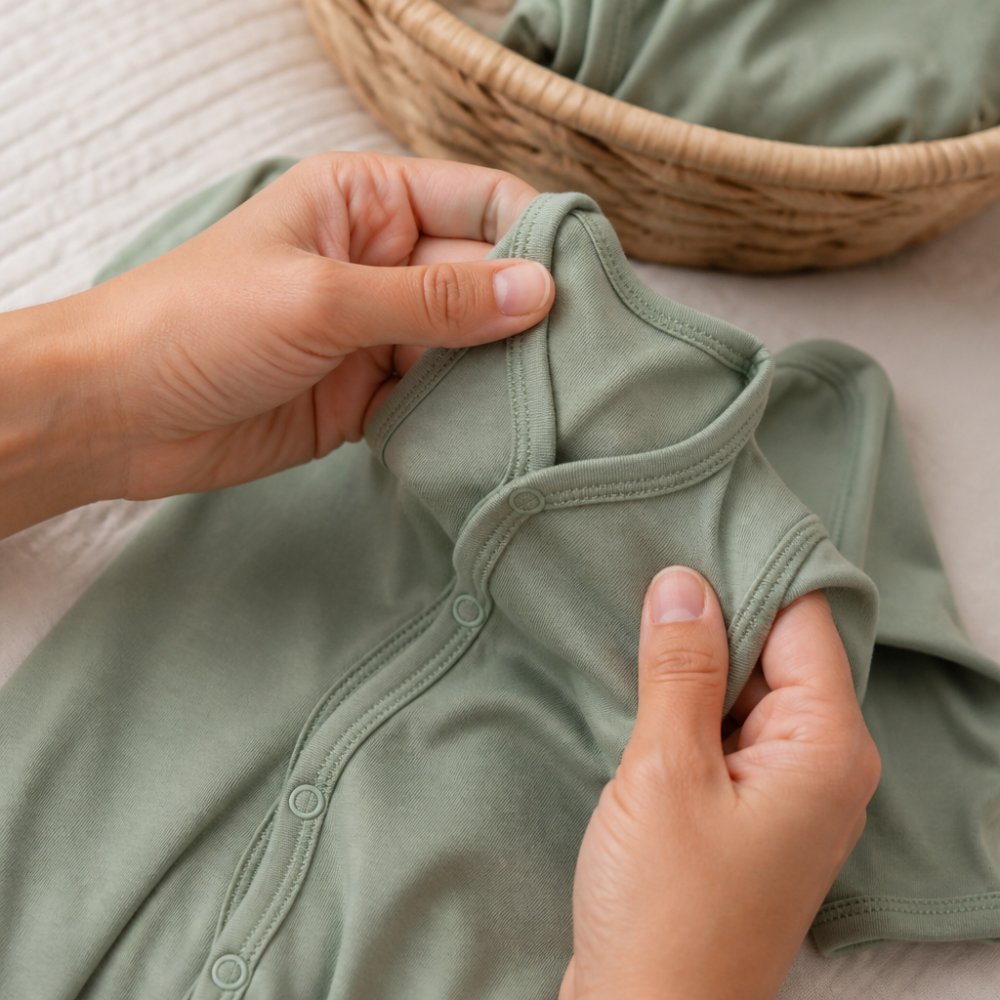
- Check the seams inside and out. Flatlock or coverstitch seams lie flat against skin; bulky overlocked seams create ridges that bother sensory-sensitive babies. Look for tag-less necklines or printed labels rather than scratchy woven tags.
- Inspect stress points. Armholes, crotch seams, and necklines take the most strain. Even, tight stitching with no loose threads or skipped stitches signals better construction.
- Test the closures. Zippers should glide without snagging; snaps should seat firmly; magnetic closures should hold through a tug. Buttons on baby clothes are a choking and fuss risk, so most quality bamboo lines avoid them.
- Check for pre-shrinking. If the garment is not pre-shrunk, plan for roughly 5-10% shrinkage in the first wash. Pre-shrunk fabric holds its labeled size.
- Look at dye evenness. Uneven color, especially at seams and hems, can indicate rushed finishing. It is cosmetic, but it correlates with overall quality control.
The lifecycle question most shoppers skip
Sustainability is not just how the fiber was made, it is how long the garment lasts and what happens to it afterward. Bamboo viscose is durable enough for gentle wear but less abrasion-resistant than cotton, so it wears out faster in heavy rotation: a cheaper cotton garment that survives three children can beat a pricier bamboo garment that pills after one season. To assess lifecycle honestly, ask:
Orchid Gardens Convertible Romper →
- How many washes will it survive? Cold-water washing and low-heat drying extend bamboo's life significantly. Hot water and high heat shorten it.
- Does it shed? Cellulosic fibers like bamboo viscose can shed microfibers during washing. Washing less often and using a microfiber-catching laundry bag reduces what reaches waterways.
- Can it be repaired? Simple seam repairs and replacing a zipper can add a season or more. Garments with accessible seams are easier to fix than fully bonded or seamless constructions.
- Can it be resold or handed down? Bamboo baby clothes in good condition hold resale value in parent communities. Buying a slightly higher-quality garment with the intent to resell or pass it on lowers the effective cost.
The Downsides of Bamboo Fabric You Should Know
Bamboo fabric has real limitations worth knowing before you buy.
Chemical processing: Bamboo viscose requires harsh chemicals to break down the pulp.
Shrinkage: Bamboo viscose shrinks more than cotton.
Pilling: Bamboo fibers are shorter than cotton fibers.
Cost: Bamboo clothes cost more than cotton.
Moisture sensitivity: While bamboo wicks moisture away, it also absorbs it.
These downsides don't make bamboo bad.
How to Care for Bamboo Baby Clothes to Extend Their Life
Use mild detergent. Harsh detergents damage bamboo fabric.
Skip the fabric softener. It coats the fibers and reduces breathability.
Fold immediately after drying. This prevents wrinkles and keeps the fabric looking fresh.
Wash with similar colors. Bamboo fabric can bleed slightly in the first few washes.
Avoid bleach. It damages bamboo fibers. For stains, use oxygen-based stain removers instead.
Don't over-wash. Wash only when truly dirty.
Proper care can add months or even years to the life of bamboo baby clothes. Our Pink Blossom Convertible Romper is designed to last through careful washing: the two-way zipper makes changes easy, and the fold-over feet adjust coverage as your baby grows.

Your Garment Inspection Checklist
Before you buy any bamboo baby clothes, use this checklist to evaluate quality.
- Certifications: Check for GOTS, Fair Trade, or other verified labels
- Fabric blend: Confirm it's 95% bamboo viscose or higher with spandex for stretch
- Seams: Look for flat seams or tag-less construction on the inside
- Softness: Feel the fabric, it should be smooth and slightly cool
- Weight: Heavier blends (200+ gsm) hold up better
This checklist helps you spot quality garments that will actually work for your baby's needs. Our Coral Reef Bamboo Baby Shortie Romper includes moisture-wicking fabric, temperature regulation, and exclusive artist-designed prints.
Choosing sustainable bamboo baby clothes means balancing softness, durability, and environmental responsibility. Explore our collection of convertible rompers and find the perfect fit for your little one's comfort and your family's values.
Frequently Asked Questions
Is bamboo viscose safe and comfortable for babies?
Yes, bamboo viscose is safe for babies when sourced responsibly. The fabric is hypoallergenic and antibacterial, making it ideal for sensitive skin. Bamboo viscose is soft, breathable, and moisture-wicking, which helps regulate temperature and keep babies dry. Look for certifications like OEKO-TEX Standard 100 or Global Organic Textile Standard (GOTS) to ensure chemical processing is minimized. Products like the Orchid Gardens Convertible Romper use 95% organic bamboo viscose blended with 5% spandex for stretch and durability.
How should you wash bamboo baby clothes to make them last?
Machine wash bamboo baby clothes in cold water on a gentle cycle, then tumble dry on low heat. Avoid bleach, fabric softeners, and hot water, which can damage the fibers and reduce softness over time. Turn garments inside out before washing to protect prints and reduce pilling. Wash with similar colors to prevent dye bleeding. Most quality bamboo pieces, including Doodlebug's rompers, hold up well to frequent washing when cared for properly. Air-drying extends garment life further if you have time.
What are the downsides of bamboo fabric for baby clothes?
Bamboo fabric requires careful processing to be sustainable, and the viscose production method uses chemicals like sodium hydroxide. If not managed responsibly, this can impact water systems. Bamboo fabric is also more delicate than cotton and can pill with friction or aggressive washing. It may stretch over time with repeated wear, though a small spandex blend (like 5%) helps. Costs are typically higher than basic cotton options. Verify certifications to ensure the processing minimizes environmental harm and chemical residue.
How can you tell whether bamboo baby clothes are sustainably made?
Look for third-party certifications like GOTS (Global Organic Textile Standard), OEKO-TEX Standard 100, or FSC (Forest Stewardship Council) labels, which verify responsible sourcing and chemical limits. Check the brand's transparency about where bamboo is sourced and how it's processed. Reputable brands disclose their supply chain and manufacturing practices. Ask about water use, pesticide avoidance, and waste management. Fair-trade certifications indicate ethical labor practices. Brands committed to sustainability will provide detailed sourcing information and certifications rather than vague marketing claims.