Quick Summary
The best organic cotton pajamas for sensory-sensitive kids are tagless, flat-seamed sets in long-staple Pima cotton, which feel smoother than standard cotton and pill less over time. Choose a relaxed fit, avoid fasteners that bother your child, and wash them without fabric softener to keep them soft.
- Tags, seams and closures are the most common triggers for clothing sensitivity.
- Organic cotton is a fiber standard, not a guarantee of softness.
- Long-staple Pima cotton has fewer exposed fiber ends, so it feels smoother.
- Skip fabric softener and dryer sheets, since they leave residue that changes how fabric feels.
- Run an extra rinse on pajama loads to remove detergent film.
Table of Contents
- Why Tags, Seams and Fabric Choice Matter for Sensory-Sensitive Kids
- How to Choose Pajamas That Feel Right: Fit, Seams and Closures
- Organic Cotton vs. Bamboo Pajamas: Which Fabric Suits Your Child
- Best Organic Cotton Pajamas for Sensory-Sensitive Kids Compared
- Keeping Sensory-Friendly Pajamas Soft Through Laundry
- Choosing Your Child's Next Pair of Sensory-Friendly Pajamas
- Frequently Asked Questions
Why Tags, Seams and Fabric Choice Matter for Sensory-Sensitive Kids
Tags, seams and fabric texture can turn a bedtime routine into a battle. For a child with sensory sensitivities, a scratchy label or a ridge of stitching can be impossible to ignore. Choosing the best organic cotton pajamas for sensory-sensitive kids starts with understanding which details cause the most trouble.
At Doodlebug's Children's Boutique, we focus on tagless construction and soft, breathable fabrics. Sensory preferences vary widely from child to child, so the goal is to reduce the triggers you can control.
Most children who react to clothing are responding to one of three things: a label rubbing the neck, a seam sitting against the skin, or a fabric that feels stiff or clingy. Removing the tag and choosing softer materials addresses the first problem directly. For more on tagless options that avoid irritating labels, see tagless organic cotton pajamas. Flat seams and a relaxed fit help with the second and third.
A common mistake is assuming that "organic" automatically means "soft." Organic cotton is a fiber standard, not a texture guarantee. Check how the garment is finished, how the seams are sewn and whether the neckline is cut in a way that avoids pressure.
How to Choose Pajamas That Feel Right: Fit, Seams and Closures
Look for tagless or printed-tag construction, flat or exposed-free seams, and closures that do not dig in. Fit matters as much as material. A snug fit can feel secure to some children and unbearable to others, so consider your child's preferences before you buy.
Start with the neckline and the waistband. Many sensory-sensitive children tolerate a soft elastic waist better than a structured one. Check whether the sleeves and legs have enough room to move without pulling at the seams.
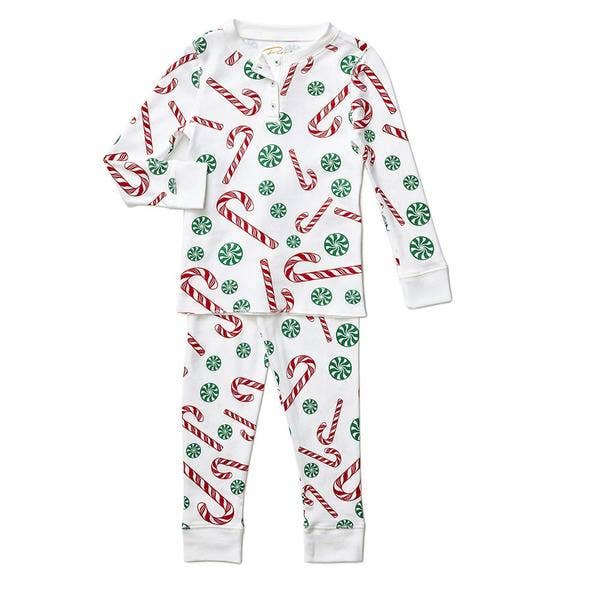
Closures need the same attention. Buttons, snaps and zippers can all become triggers. The Candy Cane Pima Kid Christmas Pajama has a long-sleeve top with three matched buttons, so if your child dislikes fasteners, you may want to choose a style without them or test the buttons before bedtime.
Pajamas that do not feel right in the store often feel worse after a full night's sleep. If possible, have your child try on a set and move around for several minutes before you decide.
Organic Cotton vs. Bamboo Pajamas: Which Fabric Suits Your Child
Organic cotton and bamboo viscose are two fibers often considered for sensory-sensitive sleepwear. Understanding how each one feels can help you match the fabric to your child's specific triggers.
Organic cotton is a growing standard, not a texture. It refers to cotton grown without synthetic pesticides or fertilizers and processed without the finishes conventional cotton often carries. What determines how it feels is the fiber length and the knit. Standard cotton has shorter fibers, so short ends poke out of the yarn and create a slightly rougher surface. Long-staple cottons, Pima and Egyptian among them, have fewer exposed fiber ends, which is why they feel smoother and pill less over time.
Bamboo viscose is a regenerated fiber: bamboo pulp is chemically dissolved and spun into filament, so the resulting fabric has a smooth, almost liquid drape. That construction is why bamboo is often described as silkier and cooler to the touch. The trade-off is stretch recovery. The Kickee Pants Falcon Snow set blends 95% viscose from bamboo with 5% spandex, and that spandex is what lets a snug fit move with a child instead of binding.
Here is how the two compare on the factors that matter at bedtime:
- Surface feel: Long-staple cotton is smooth but has a faint matte texture; bamboo viscose is slicker and cooler. A child who rejects "fuzzy" or "grippy" fabric often accepts bamboo; a child who dislikes cool, slippery fabric often prefers cotton.
- Temperature: Cotton breathes well and absorbs moisture, which suits a child who runs warm or sweats at night. Bamboo viscose wicks quickly but feels cooler on contact, which can be a plus in summer and a drawback for a child who wants warmth.
- Stretch and fit: Cotton knits have modest give; a snug cotton set relies on the cut rather than elastane. Bamboo blends with spandex stretch more and recover better, which matters for children who move a lot in sleep.
- Durability: Long-staple cotton holds up to repeated washing with less pilling. Bamboo viscose is more prone to pilling and to losing shape if washed hot or dried on high heat.
- Certifications to check: OEKO-TEX Standard 100 covers the finished garment; look for it on the listing. For cotton, also check whether the brand states organic fiber content, since "organic" and "OEKO-TEX certified" are separate claims.
Watch out: a listing that says "bamboo" without a percentage may be a blend with conventional cotton or polyester, and the feel will not match a high-viscose bamboo set. Check the fiber breakdown before you buy.
A practical approach is to try one set in each fiber and let your child sleep in both before committing to a full rotation. Keep a note of the fiber content, the fit and the wash result for each.
Best Organic Cotton Pajamas for Sensory-Sensitive Kids Compared
The right pick depends on your child's comfort needs, your holiday budget and how much fit and texture matter. Below we compare the options available at Doodlebug's Children's Boutique.
| Product | Fabric | Closure | Starting Price | Best For |
|---|---|---|---|---|
| Candy Cane Pima Kid Christmas Pajama | 100% Pima cotton | Three buttons | $41.99 | Families who want a festive, soft cotton set |
| Jingle Bells Christmas Holiday Kid Pajamas | 100% Peruvian Pima cotton | Three buttons | $41.99 | Holiday photos and cozy evenings |
| Pink Ice-Skating and Snowmen Toddler Pajamas | 100% Peruvian Pima cotton | Three buttons | $41.99 | Toddlers who like a winter print |
| Kickee Pants Falcon Snow Bamboo Pajama Set | 95% bamboo viscose, 5% spandex | Pull-on, no buttons listed | $19.99 | Children who prefer a silky, stretchy feel |
Starting Price
Pima Cotton Holiday Sets: Candy Cane, Jingle Bells and Ice-Skating
The three Petidoux holiday sets share the same fabric and construction. Each is made from 100% Pima cotton, pre-washed and pre-shrunk, and carries OEKO-TEX Standard 100 certification. Each is priced at $41.99.
Candy Cane Pima Kid Christmas Pajama
- Pros: Ultra-soft Pima cotton, OEKO-TEX certified, pre-shrunk
- Cons: Three buttons may bother children who dislike fasteners
- Best for: Families who want a festive cotton set at bedtime
Jingle Bells Christmas Holiday Kid Pajamas
- Pros: Two-piece snug fit, lead-free buttons, Fair Trade and WRAP certified manufacturing
- Cons: Snug fit means you should size up if your child prefers room
- Best for: Parents who value certified manufacturing
Pink Ice-Skating and Snowmen Toddler Pajamas
- Pros: Soft pink and purple palette, lead-free screen printing, machine washable
- Cons: The snug fit may not suit every toddler
- Best for: Toddlers who enjoy a winter print
Kickee Pants Falcon Snow Bamboo Set
The Kickee Pants set is the lowest-priced option at $19.99. The listing describes a tagless design, a snug fit and a bamboo viscose blend that is lightweight and breathable.
- Pros: Silky bamboo fabric, tagless design, lightweight for all-night wear
- Cons: Fitted stretch design may feel tight to some children
- Best for: Kids who prefer a smooth, stretchy layer
Keeping Sensory-Friendly Pajamas Soft Through Laundry
Care instructions usually stop at washing and drying. Laundry residue can also change how a garment feels over time for some sensory-sensitive children. For guidance on washing soft fabrics without losing their feel, see our machine-washing notes.
Why residue matters. Fabric softeners and dryer sheets can leave a coating on fabric that some children notice as slick or waxy, and that coating can build up over repeated washes. If your child's pajamas feel different after a few weeks, residue is worth ruling out.
A laundry routine built for sensory skin:
- Use a free-and-clear detergent with no added fragrance or dyes, and measure to the low end of the recommended dose. More detergent does not mean cleaner clothes; it means more residue.
- Skip fabric softener and dryer sheets entirely on pajamas. If static is a problem, use wool dryer balls instead.
- Run an extra rinse cycle on pajama loads. This is the single most effective step for removing detergent film.
- Wash inside out to protect seams and prints, and to expose the skin-side surface to the rinse water.
- Tumble dry low or line dry. High heat can stiffen cotton and shrink stretchy bamboo blends, and it can set residue into the fiber.
- Wash new pajamas before the first wear. New garments can carry manufacturing finishes and packaging residue that a single wash removes.
Watch out: "gentle" or "baby" detergents are not automatically fragrance-free. Check the ingredient list for "fragrance" or "perfume" rather than trusting the front label.
Rotate to reduce wash frequency. A child who wears the same pair every night puts that garment through far more wash cycles, and each cycle is a chance for residue to build and for the fabric to stiffen. Keeping three or four sets in rotation lets each pair rest and reduces the wear per garment.
When to strip the fabric. If pajamas feel stiff or waxy despite your routine, a one-time strip, washing in hot water with a small amount of washing soda and no detergent, then running a second rinse, removes accumulated film. Do this sparingly, since hot water is hard on stretch fibers, and follow with a cool wash to restore the hand feel.
Match the wash routine to the fiber. Long-staple cotton tolerates warmer washes and holds its smooth surface well. Bamboo viscose blends are more sensitive to heat and agitation, so keep them on a gentle cycle and out of a hot dryer.
Choosing Your Child's Next Pair of Sensory-Friendly Pajamas
Start with what your child already tolerates, then move to a fabric or fit that addresses a known trigger. If tags are the main problem, choose tagless options. If fasteners bother your child, look for pull-on styles. If your child runs warm, consider a lighter weight.
At Doodlebug's Children's Boutique, we carry tagless and sensory-conscious sleepwear. Browse the collection to find a set that fits your child's comfort needs and your family's style.
Frequently Asked Questions
What are the best pajamas for kids with sensory issues?
The best pajamas for kids with sensory issues are usually tagless, have flat or no seams, and use a soft, breathable fabric. Organic cotton and bamboo blends are popular because they feel gentle against skin. Doodlebug's carries options such as the Kickee Pants Falcon Snow Bamboo Pajama Set, which is tagless and made from 95% bamboo viscose and 5% spandex, starting at $19.99. Start with one set and see how your child responds before buying a full wardrobe.
Are organic cotton pajamas good for kids with sensitive skin?
Organic cotton pajamas can suit kids with sensitive skin because they are made from a natural fiber. The Doodlebug's holiday sets are made from 100% Peruvian Pima cotton, are OEKO-TEX Standard 100 certified, and are pre-washed and pre-shrunk. Priced at $41.99, they are a good option for families who want a natural fiber. Note that a snug fit is recommended, so sizing up may be necessary for comfort.
What features make pajamas sensory-friendly for kids?
Sensory-friendly pajamas usually have tagless designs, flat seams, soft-touch fabric, and simple closures instead of zippers, snaps or buttons that can trigger discomfort. Breathability and a non-restrictive fit also matter, since overheating or tight elastic can cause meltdowns. Doodlebug's Pima cotton sets use three matching buttons on the top, while the Kickee Pants bamboo set is tagless with a fitted, stretchy design. Check whether a set's closure type suits your child before ordering.
Are tagless pajamas better for children with sensory sensitivities?
For many children, tagless pajamas reduce scratching and irritation at the neck, which is a common sensory trigger. Doodlebug's Kickee Pants Falcon Snow set is described as tagless, which helps for kids sensitive to labels. Because every child responds differently, compare the fabric, seam placement and closures alongside the tag. Trying a set on before washing, as the product care guidance recommends, helps you judge fit and feel.
