Last Updated: October 31, 2026
Quick Summary
Choose sensory-friendly school supplies by starting with your child's sensory profile, not the supply list. Observe behaviors across the school day, match one tool to one need, and buy only for the senses your child actually struggles with. A supply works only if your child uses it, the teacher allows it, and your trial log shows it helps.
- Fill out a three-column sensory profile over three to five school days before buying anything.
- A fidget supports attention while a weighted lap pad supports settling; one won't fix the other.
- Trial a new sensory tool for one to two weeks and change only one thing at a time.
- Confirm classroom rules with the teacher before day one so the tool isn't confiscated.
- Prioritize clothing first, then one fidget, labels, and headphones or a lap pad only if confirmed.
Table of Contents
- Start With Your Child's Sensory Profile, Not the Supply List
- Your Sensory-Friendly School Supplies Checklist
- Choosing a Sensory-Friendly Backpack for Kids
- Fidget Tools for School That Teachers Actually Allow
- Sensory-Friendly Clothing for School: Seams, Tags, and Fasteners
- Trial, Feedback, and Measuring What Actually Helps
- Safety, Age Suitability, and Supervision at School
- Budgeting and Prioritizing Your First Order
- Frequently Asked Questions
Start With Your Child's Sensory Profile, Not the Supply List
Most parents start with a list of sensory-friendly school supplies and work backward. That's the wrong order. The right order starts with your child.
A sensory-friendly supply is one that reduces or manages the sensory input a child receives during the school day.
A tool that works for one child can fail for another, and the match matters more than the product itself.
Before you spend a dollar, spend ten minutes building a simple sensory profile. It's the step most product roundups skip, and it determines whether anything you buy gets used.
Build a Three-Column Sensory Profile
A sensory profile doesn't need to be clinical. A single sheet of paper with three columns is enough to turn vague observations into a buying decision.
| Column | What to write | Example |
|---|---|---|
| What I see | Specific behaviors, times, and settings | Covers ears at the cafeteria bell; chews shirt collar during silent reading |
| What sense it points to | Sound, touch, movement, pressure, oral, visual, smell | Sound sensitivity; oral input need |
| What might help | One tool category per need | Noise-reducing headphones; chew-safe tool |
Fill this out over three to five school days. Don't try to catch everything in one morning. Patterns matter more than single incidents.
Observe Across the Whole School Day, Not Just Homework Time
School sensory demands differ from home. A child who seems fine at the kitchen table may struggle in a loud cafeteria, crowded hallway, or fluorescent-lit classroom.
Watch for these common patterns and what they usually point to:
- Covers ears or hums in loud spaces: sound sensitivity. Consider noise-reducing headphones, not full canceling.
- Chews sleeves, pencils, or collars: oral input need. Consider chew-safe tools or a straw bottle.
- Pushes hard against the table, wall, or floor: proprioceptive (deep pressure) need. Consider a weighted lap pad or compression clothing.
Separate 'Focus' Needs From 'Calming' Needs
A fidget supports attention; a weighted lap pad supports settling. They solve different problems, and one won't fix the other.
Ask two questions for each observed behavior:
- Is this happening when my child is under-aroused and needs input to stay alert? That points to fidgets, movement tools, or oral input.
- Is this happening when my child is over-aroused and needs input to calm down? That points to deep pressure, noise reduction, or a quiet retreat space.
A child can have both needs at different times of day, which is why one tool rarely covers a whole school day.
Match the Tool to the Need
Here's how the common sensory needs line up with the supplies that address them:
- Sound sensitivity: noise-reducing headphones
- Need to move: wiggle cushion, flexible seating, a band on chair legs
- Need to fidget: discreet hand-held fidgets, fidget pens
A common mistake is buying several tools for the same sense. Two fidgets don't equal one working fidget. Start with one need, one tool.
When to Ask for Help
If the profile shows needs across four or more senses, or if your child is consistently leaving school exhausted or distressed, a school occupational therapist or your pediatrician is the right next call. A supply list can't replace an evaluation, and it isn't meant to.
Your Sensory-Friendly School Supplies Checklist
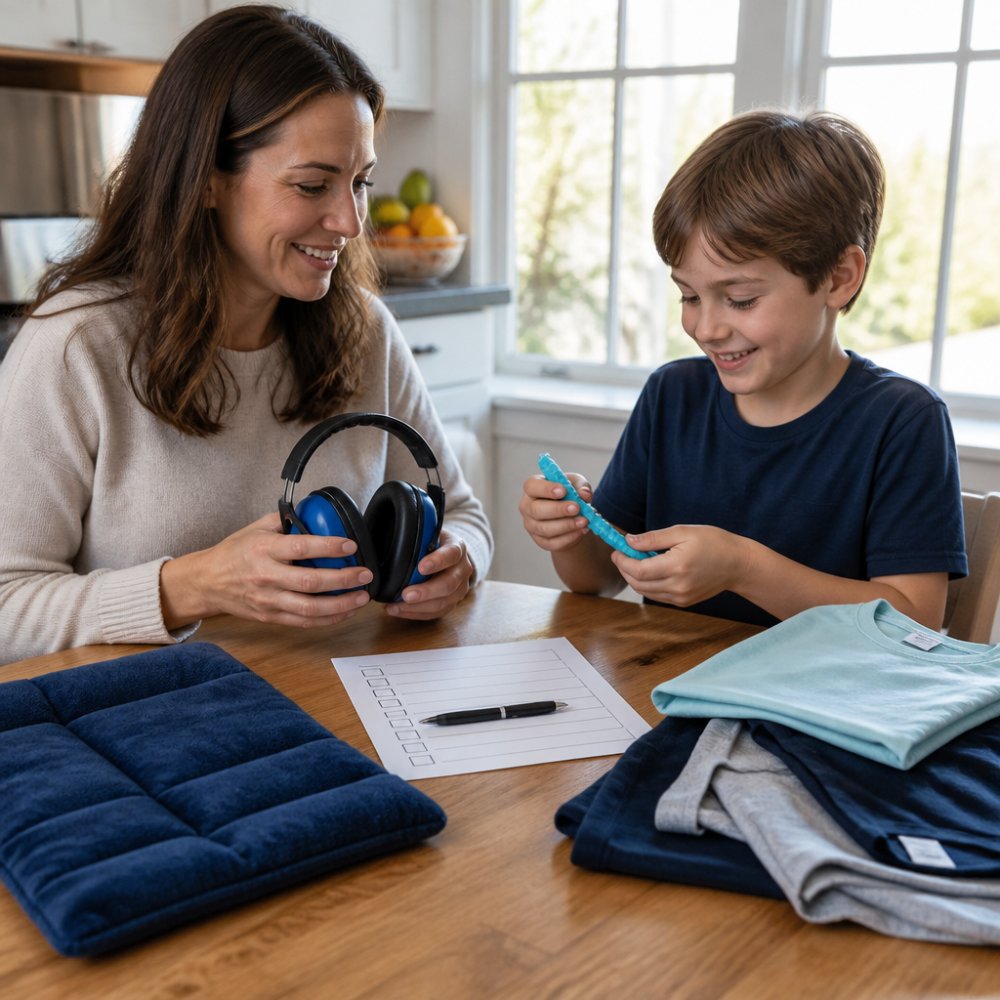
A working sensory-friendly school supplies checklist covers six areas: sound, movement, touch, pressure, fidgets, and clothing. Buy only for the areas your child actually struggles with.
Here's the checklist we'd use:
- Noise-reducing headphones, if sound is a trigger
- One discreet fidget your child chose themselves
- A wiggle cushion or seat band, if sitting still is hard
That last item gets skipped constantly. A two-line note to the teacher prevents most confusion that sinks these tools.
Choosing a Sensory-Friendly Backpack for Kids
A sensory-friendly backpack for kids should distribute weight evenly across both shoulders, sit flat against the back, and open without a fight.
What most guides miss: the backpack itself can be a sensory tool or a sensory problem.
Look for:
- Wide, padded shoulder straps
- A chest strap to keep weight centered
- Smooth, non-scratchy lining
Small extras count too. A clip-on sensory accessory, like a light-up squishy keychain fidget, gives kids something to touch on the walk in without digging through the bag.
Fidget Tools for School That Teachers Actually Allow
Fidget tools for school work when they're quiet, small, and clearly purposeful.
Teachers generally accept a fidget that stays in one hand, makes no noise, and doesn't require looking at it.
Fidget pens are a smart middle ground because they look like ordinary school supplies. We carry a squishy mushroom fidget pen that squishes while it writes, and a slow-rising axolotl fidget pen for kids who like a slower, more satisfying squeeze.


For more quiet options, our guide to quiet fidget toys for school covers what tends to survive a classroom.
10-Color Shuttle Pen – Multicolor Pen for Kids →
Watch out: a fidget only helps if the teacher knows its purpose.
Sensory-Friendly Clothing for School: Seams, Tags, and Fasteners
Sensory-friendly clothing for school removes the three most common irritants: tags, rough seams, and hard fasteners. Tag-less designs and soft, flat seams do most of the work.
A tag scratching the neck can ruin a whole morning, as can a digging waistband or a snap pressing into skin when a child sits.
If your child complains about seams and tags, it helps to understand why. Our article on ADHD and clothing sensory issues explains what's happening. For a practical fix, here's how to remove clothing tags without damaging the fabric.
When you shop, check for:
- Tag-less necklines
- Flat or covered seams
- Elastic waistbands instead of buttons and snaps
Trial, Feedback, and Measuring What Actually Helps
Trial a new sensory tool for one to two weeks. Ask your child and the teacher two questions: did it help, and did anyone notice it in a bad way?
Keep the trial small. One tool at a time, so you know what worked. If you change three things at once and things improve, you've learned nothing.
But a trial only works if the tool is allowed to be used.
Coordinate With the Teacher Before the Trial Starts
A five-minute conversation or a short note prevents most of the confusion that ends with a tool in a desk drawer. Cover four things:
- What the tool is and what it's for. Name it plainly: "This is a noise-reducing headphone for loud transitions, not a toy."
- When it can be used. During independent work? Tests? Hallway transitions? Assemblies? Be specific.
- Where it lives. In a desk, in a backpack, or with the teacher? A tool that travels home nightly gets lost.
- What the teacher should watch for. Ask them to note whether your child seems calmer, more focused, or more distracted.
If your school has a written policy on personal sensory items, ask to see it. Many classrooms allow quiet fidgets and headphones but restrict anything toy-like, noisy, or requiring supervision. Knowing the rule before you buy saves returns.
Use a Simple Trial Log
A trial log turns a vague feeling into a decision. Keep it short enough that you'll actually fill it out.
| What to track | How to check it | What it tells you |
|---|---|---|
| Child's feedback | Ask at the end of each day | Whether it feels good to use |
| Teacher feedback | Short weekly note or message | Whether it disrupts class |
| Visible settling | Fewer meltdowns or exits | Whether it calms |
| Focus | Finished work, fewer redirections | Whether it helps attention |
| Logistics | Did it come home? Was it lost or broken? | Whether it's practical to keep |
Review the log at the end of week two. If two or more rows improved and none got worse, keep the tool. If nothing changed, stop using it and try a different category.
Agree on an Exit Plan
Tools stop working. A fidget that helped in September may distract in November. Agree with the teacher up front that either of you can pause the tool without it being a failure.
A simple exit plan:
- Pause, don't discard. Put the tool away for two weeks and see if behavior changes.
- Swap categories, not products. If a fidget stopped helping, try a movement tool before buying another fidget.
- Tell your child. Kids handle a paused tool better when they know it's a test, not a punishment.
If a tool fails, that's information, not waste. It narrows the next choice.
Safety, Age Suitability, and Supervision at School
Safety comes before comfort. Check age recommendations, small parts, cords, and anything that could become a hazard during an unsupervised moment.
A few rules we'd apply to any sensory supply:
- Follow the age guidance on the product, not your child's maturity
- Avoid long cords or straps that could catch on furniture
- Skip anything with loose small parts for kids who mouth objects
Noise-reducing headphones deserve a specific note. Full noise-canceling can leave a child cut off from the teacher. Many families do better with reducing rather than canceling. Talk to your child's teacher or occupational therapist about what level makes sense.
Budgeting and Prioritizing Your First Order
Buy one tool per need, start with the cheapest fix, and add only what proves useful. Most families overspend on supplies that never leave the backpack.
Here's how we'd prioritize a first order:
- Clothing first. It's worn every day, so a tag-less shirt earns its cost fast.
- One fidget. Cheap, low-risk, easy to replace.
- Labels. Lost supplies cost more than labels do. A personalized name stamp kit marks clothing and gear so things come home.
- Headphones or a lap pad. Buy these only if sound or pressure is a confirmed need.
- Everything else. Wait until the first four prove themselves.
Durability matters as much as price, since a cheap item that falls apart quickly can cost more over time than a sturdier one.

Frequently Asked Questions
What school supplies are best for kids with sensory needs?
The best supplies match your child's specific sensitivities rather than a generic list. Start with the items that address their biggest triggers: noise-reducing headphones for sound sensitivity, tag-less and seam-free clothing for touch sensitivity, and discreet hand-held fidgets for kids who need movement to focus. A weighted lap pad can help during seated work. Try one or two items at a time so you can tell what is actually helping before you buy more.
Should I ask my child's teacher before buying fidget tools for school?
Yes, and early. Many classrooms have rules about what counts as a tool versus a toy, and a quick conversation prevents your child's fidget from being confiscated in week one. Explain what the tool does, ask where it can be kept, and agree on ground rules such as one fidget at a time and it stays out of sight during tests. Teachers who understand the purpose are far more likely to support consistent use.
What should I look for when choosing a sensory-friendly backpack for kids?
Look for wide padded straps that spread weight across the shoulders, a padded back panel, and a chest or sternum strap for stability. Smooth fabric and few dangling straps reduce distracting touch input, and a firm structured base keeps the bag from slumping. Check that the main compartment fits the school's required folders flat, and let your child test the fit loaded, not empty, since weight changes how a bag feels.
How do I build a sensory-friendly back-to-school kit without overspending?
Buy in order of impact. Start with the item that addresses your child's most disruptive trigger, usually clothing or sound, because those affect the whole school day. Add one fidget tool and one calming item such as a weighted lap pad, then wait two weeks and observe before adding more. Reusable items like a name stamp kit, which runs $24.99 and provides roughly 1,000 imprints, also cut replacement costs over a school year.
Picking the right tools takes some trial, and that's normal. At Doodlebug's Children's Boutique, we stock tag-less apparel made from organic and bamboo materials, plus fidget toys designed to be used quietly at a desk. Start with one need, one tool, and one week of watching what happens. Explore our sensory-friendly collection and build from there.
