
Table of Contents
- Why Sensory Fidget Toys Belong With Sensory-Friendly Clothing
- Quick Comparison: 8 Sensory Fidget Toys for Kids and Tweens
- Fidget Toys for Focus and ADHD: What Actually Helps Kids Stay On Task
- Silent Fidget Toys for School: Noise Levels Parents Should Know
- Movement-Based Sensory Tools That Work With Clothing, Not Against It
- How to Choose Sensory Toys for Children: A Practical Checklist
- Keeping Fidget Toys Clean and Comfortable for Daily Use
- Conclusion: Matching the Right Sensory Fidget Toy to Your Child
- Frequently Asked Questions
Last Updated: October 2, 2026
Why Sensory Fidget Toys Belong With Sensory-Friendly Clothing
Sensory fidget toys are small, handheld tools that give children a safe outlet for restless energy, helping them stay calm and focused without disrupting others. Paired with sensory-friendly clothing, soft, tag-less fabrics that remove one source of daily irritation, they give busy hands somewhere to go. This guide from Doodlebug's Children's Boutique covers eight options for kids and tweens, sorted by noise level, portability, and sensory input.
Here's the part most buying guides skip. A fidget only works if it matches your child's specific sensory profile. The wrong one becomes another distraction.
How Tactile Stimulation Supports Self-Regulation
Tactile stimulation is the sensory input your child's skin and hands receive through touch, and it plays a direct role in self-regulation. When a child squeezes, stretches, or rubs a textured object, that repetitive motion gives the nervous system steady feedback it can organize around, what occupational therapists call grounding.
The practical takeaway: hands need a job. A child who picks at nails, chews sleeves, or taps a desk is often searching for sensory input, not misbehaving. A fidget redirects that search into something quiet and contained.
Quick Comparison: 8 Sensory Fidget Toys for Kids and Tweens
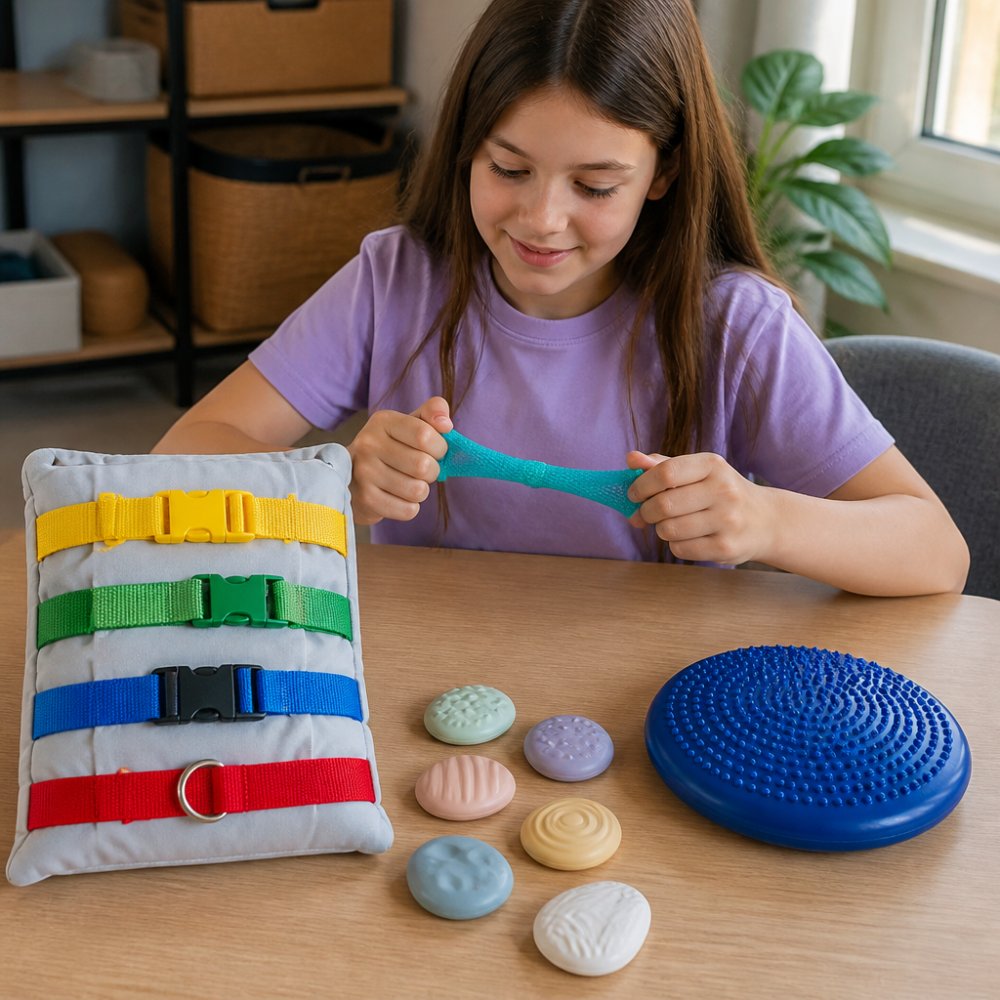
This comparison covers eight sensory fidget toys for kids and tweens, grouped by what each does best. Every option comes from Doodlebug's Children's Boutique and pairs well with tag-less, soft-fabric clothing because nothing snags, scratches, or adds a second texture problem.
| Fidget Toy | Price | Noise Level | Best For |
|---|---|---|---|
| Thingamajig Sensory Pillow | $24.99 | Silent | Ages 3-8, tactile exploration |
| Calming Stretchy Band | $14.99 | Silent | Stress relief, muscle input |
| Worry Stones (Set of 6) | $19.99 | Silent | Pockets, tests, transitions |
| Balance Cushion Sensory Seat | $32.99 | Silent | Seated focus, ages 3+ |
| Sensory Genius Sensory Mats | $19.99 | Silent | Desks and floors, ages 5+ |
| Ollie the Weighted Octopus | $68.99 | Silent | Bedtime, big feelings |
| Comfy Cozy Peapod Chair | $89.99 | Silent | Deep pressure, ages 4-10 |
| Tots Sensory Playmat Set | $79.95 | Quiet | Toddlers, motor skills |
Fidget Toys for Focus and ADHD: What Actually Helps Kids Stay On Task
Fidget toys for focus and ADHD work best when they occupy the hands without competing for attention. A toy that lights up, makes noise, or demands a decision pulls focus from the lesson; a quiet, repetitive tool absorbs restless motor output so the thinking part of the brain can settle. For kids with ADHD, the goal is on-task behavior, not stillness, many concentrate better when their hands are busy.

Match the Tool to the Sensory Profile, Not the Diagnosis
Most buying guides sort fidgets by age or product category. A more useful sort is by sensory profile, because two kids with the same ADHD diagnosis often need opposite tools. Occupational therapists group kids into two broad patterns:
- Sensory seeking. These kids crave input. They press hard on pencils, chew collars, crash into furniture, and reach for anything with resistance, weight, or texture. They do best with tools that push back: stretchy bands, weighted lap pads, textured putty, or anything requiring a firm squeeze.
- Sensory avoiding. These kids are already overstimulated. They flinch at tags, recoil from loud rooms, and prefer smooth, predictable surfaces. A bumpy or sticky fidget adds to the load rather than relieving it. They do best with smooth worry stones, a single-texture silicone pad, or a soft fabric item they can rub quietly.
A common pattern is a parent buying a bright, multi-textured fidget for a sensory-avoiding child and watching it get shoved in a drawer within a week. The tool was not bad. It was the wrong profile.
What the Mechanism Actually Does
A fidget does not 'treat' ADHD. It gives the motor system a low-stakes job so the prefrontal cortex is not spending resources suppressing movement.
This is also why the most effective fidgets are repetitive and low-novelty. A tool with a puzzle, a score, or a surprise sound keeps pulling attention back to itself; a stretchy band or smooth stone fades into the background once the hands learn the motion.
Two Tools That Fit Different Profiles
The Thingamajig Sensory Pillow fits sensory-seeking younger kids well. Its bright straps, zippers, buttons, cord, and buckles keep fingers moving while supporting tactile exploration, color identification, and counting for ages 3 to 8. It measures 7 by 5.5 by 2.5 inches and stays silent, so it works in a backpack, at a desk, or on a car trip, the variety of fasteners gives several resistances to rotate through.
For older kids and tweens, the Calming Stretchy Band offers a different kind of input. Stretching the softly resistant band provides tension release and proprioceptive feedback, and it strengthens muscles while improving spatial awareness. It runs 30 by 6 inches, stretches past 46 inches before snapping back, and is machine washable on a gentle cycle. For a sensory-avoiding tween, the Worry Stones set is often better: a single smooth stone in a pocket asks nothing of the child and draws no attention.

Also watch for over-fidgeting. Repetitive squeezing, stretching, or rubbing for long stretches can lead to sore hands, wrist strain, and in some cases repetitive strain injuries. Rotate tools, encourage breaks, and switch hands so no single set of muscles carries the load all day.
Silent Fidget Toys for School: Noise Levels Parents Should Know
Silent fidget toys for school fall into three practical categories: fully silent, quiet, and audible. Knowing which category a toy belongs to prevents the most common classroom problem, a fidget that works beautifully at home and gets confiscated by second period.
The more useful approach is to think in decibels. A rough working scale parents and OTs use:
- Fully silent (under roughly 20 dB). No moving parts that click, snap, or rattle. Silicone stones, fabric pillows, stretchy bands, and weighted plush fall here. These are safe for a silent reading block or a test.
- Quiet (roughly 20 to 40 dB). A soft, muffled sound, about the level of a whisper or a page turn. Textured mats, soft putty in a tin, and some squish toys land here. Fine for group work, risky during silent independent work.
- Audible (above roughly 40 dB). Clicks, pops, snaps, and anything with a hard plastic mechanism. These are the fidgets that get banned. Save them for home, the car, or recess.
The Tools in This Guide, Sorted by Noise
The Worry Stones set is the clearest fully silent option. Each of the six stones has a different texture, from smooth waves to tactile bumps, and the food-grade silicone stays soft and easy to clean. They fit in a pocket, pencil case, or backpack, making them discreet enough for a test or bus ride, and give kids who bite nails or pick at skin a productive outlet.
The Sensory Genius Sensory Mats sit in the quiet category. Four textures across four mats provide calming tactile input for hands and feet, and each mat measures 7.75 inches across. Kids can use them on a desk during homework or on the floor for balance work; they are recommended for ages 5 and up. Because the mats are larger, they suit a desk at home better than a pocket at school.
Thingamajig - Fun Sensory Pillow Activity Toy →
Cleaning and Hygiene: The Step Most Guides Skip
Silicone worry stones wipe clean with warm water and mild soap, and food-grade silicone handles frequent washing without breaking down. The Calming Stretchy Band goes in the washing machine on a gentle cycle and air dries.
If your child wears sensory-friendly clothing, look for soft fabrics that will not rub against a fidget held in a pocket all day. A rough seam against a silicone stone is a small problem that becomes a daily one.
Movement-Based Sensory Tools That Work With Clothing, Not Against It
Movement-based sensory tools let kids move while they stay seated, which matters when clothing and furniture need to cooperate. A balance cushion or inflatable chair gives the body an outlet, and sensory-friendly clothing removes the scratch and tug that would otherwise compete for attention.
The Balance Cushion Sensory Seat is the most portable option here. Its curved base allows side-to-side motion while the top permits subtle shifting, so kids release restless energy without leaving their seat. Textured dimples add quiet sensory input, and the design engages the core to support posture. It ships pre-inflated at 13.5 inches in diameter, includes a hand pump, wipes clean with a damp cloth, and supports up to 300 pounds for ages 3 and up.

For deeper pressure, the Comfy Cozy Peapod Inflatable Chair wraps kids in a soft, calming embrace. The flocked vinyl feels like velvet, and the triple-welded seams hold up to daily use.
How to Choose Sensory Toys for Children: A Practical Checklist
Choosing sensory toys for children comes down to matching the tool to the child's sensory profile, the setting, and the child's age. Start with what the child already does when they need to settle, then pick a tool that supports that behavior.
Use this checklist before you buy:
- Identify the behavior: does your child chew, pick, tap, or rock when overwhelmed?
- Match the input type: tactile, proprioceptive, or movement-based
- Check the noise level against the setting, especially for school
- Confirm the age range and weight limit for the specific product
- Test portability: will it fit in a pocket, backpack, or pencil case?
- Ask your child's OT or teacher if the tool will be allowed in class
- Start with one tool, not five, and observe for a week
Keeping Fidget Toys Clean and Comfortable for Daily Use
Comfort matters too. Check for rough edges, worn straps, or stretched bands every few weeks, and rotate tools so no single one becomes a chew target. If your child wears sensory-friendly clothing, look for soft fabrics that will not rub against a fidget held in a pocket all day.
Conclusion: Matching the Right Sensory Fidget Toy to Your Child
Every child's sensory profile is different, and the right fidget is the one that fits theirs. A quiet tool that matches how your child already self-regulates will do more than a shelf full of options.
At Doodlebug's Children's Boutique, we built our collection around that idea. Our tag-less clothing in organic and bamboo fabrics removes one layer of daily irritation, and our fidget toys give kids a calm, engaging outlet. The Thingamajig Sensory Pillow suits younger kids who need tactile exploration, the Worry Stones fit tweens who want something discreet, and the Balance Cushion Sensory Seat helps kids who focus better in motion.
Frequently Asked Questions
What can I use instead of a fidget spinner?
Spinners draw attention because they're visual and noisy, so many classrooms now avoid them. Quieter alternatives work better for school. The Thingamajig sensory pillow ($24.99) keeps hands busy with zippers, buttons, and cord while staying silent. Silicone worry stones and stretchy bands also give repetitive motion without sound. If your child needs whole-body movement, a balance cushion lets them shift and rock while seated. These options support tactile stimulation and self-regulation without disrupting classmates, which is why occupational therapists often recommend them over spinners for classroom use.
How do fidget toys help children wearing sensory-friendly clothing stay focused?
Sensory-friendly clothing removes scratchy tags and rough seams, so your child isn't spending mental energy on irritation. That frees attention for learning. A fidget toy then gives restless hands a calm outlet, providing tactile stimulation that supports on-task behavior. Together they address two sides of the same problem: what touches the skin and what the hands do. For kids with ADHD or sensory processing needs, pairing tag-less apparel with a silent fidget like worry stones or a stretchy band can reduce fidgeting that disrupts others while still meeting the body's need for movement and sensory input.
Are there silent fidget toys suitable for classroom environments?
Yes. Silent fidget toys for school include silicone worry stones, stretchy bands, and soft sensory pillows with zippers and buckles. The Thingamajig ($24.99) is designed to enable fidgeting motion without disturbing others and fits in a backpack. Worry stones ($19.99 for a set of six) are pocket-sized and quiet enough for tests and bus rides. The balance cushion ($32.99) offers silent sensory support through textured dimples and gentle movement. Look for items described as silent or noise-free, and check with your child's teacher before sending anything to class.
What materials are best for sensory-friendly fidgets?
Soft, non-toxic materials work best. Food-grade silicone is a strong choice because it's durable, easy to clean, and soft to the touch, which is why worry stones use it. Fabric-based fidgets with straps, zippers, and cord suit kids who prefer texture variety. Stretchy bands made from softly resistant material support pulling and twisting without snapping. Avoid hard plastic toys with small parts for younger children. Whatever you pick, check that it's safety tested and free of phthalates and latex, especially if your child has sensitive skin or puts toys near their mouth.
How can I integrate fidget toys into a sensory-friendly wardrobe?
Think of fidgets as wearable or carryable accessories that match your child's clothing routine. Pocket-sized worry stones slip into pants or jacket pockets, so they're available during transitions. A stretchy band can stay in a backpack or be looped around a wrist. For kids who need deep pressure, a weighted plush like Ollie the Weighted Octopus ($68.99) pairs well with soft, tag-less pajamas at bedtime. Keep one fidget in each bag, car, and calm-down corner so the tool is always within reach when your child needs tactile stimulation or stress relief.
Finding the right combination of comfort and calm takes some trial and error, and that is exactly where we can help. Doodlebug's Children's Boutique pairs sensory-friendly clothing with fidget toys designed for real daily use, from tag-less organic and bamboo apparel to fair-trade pieces your child will actually want to wear. Explore the collection and build a sensory toolkit that fits your child's needs.