Last Updated: November 4, 2026
Quick Summary
To spot greenwashing in kids fashion, match every claim on the tag to evidence you can see: a fiber percentage, a named certification, or a specific number. If a claim has none of those, treat it as marketing rather than proof. Vague words like eco-friendly or sustainable mean little unless the label backs them up.
- Vague phrases like eco-friendly, sustainable, and green have no fixed meaning and should be treated as questions, not answers.
- Use the five-question worksheet: what is claimed, which part it covers, is there a percentage, is a certification named, and does the brand admit trade-offs.
- Certifications verify a narrow slice: GOTS covers organic fiber plus processing, while OEKO-TEX Standard 100 tests finished articles for harmful substances.
- Verify a certificate by looking up its number on the certifying body's own site and checking the scope line and dates.
- Durability is the sustainability claim most brands skip, so check fabric weight, reinforced seams, and closure quality before buying.
Table of Contents
- Why Greenwashing in Kids Fashion Is So Hard to Catch
- Greenwashing in Fashion Examples Every Parent Should Know
- How to Check Clothing Sustainability Claims Before You Buy
- Clothing Sustainability Certifications: What They Cover and What They Don't
- What Organic Cotton Kids Clothing Labels Actually Promise
- Reading a Garment's Whole Lifecycle, Not Just Its Label
- Shopping Doodlebug's for Clothes You Can Actually Verify
- Frequently Asked Questions
Why Greenwashing in Kids Fashion Is So Hard to Catch
Greenwashing in kids fashion is when a children's clothing brand makes its products sound more eco-friendly than they really are.
The hardest part is that most claims are technically true. A shirt can say "eco-friendly" and mean almost nothing, since no law forces a brand to define that phrase.
Below, we'll show you how to read a label like a skeptic, which words carry proof and which carry air.
The three most common vague phrases brands hide behind
Some phrases show up again and again because they are safe for the brand and useless for you:
- "Eco-friendly" has no fixed meaning. It is a feeling, not a fact.
- "Sustainable" can describe a single fabric choice while the rest of the garment stays unchanged.
- "Green" or "planet-friendly" usually signals a marketing team, not a supply chain.
When you see these words alone, treat them as a question, not an answer. The real test is whether the label backs them up with a material, a certification, or a number.
Greenwashing in Fashion Examples Every Parent Should Know
The clearest greenwashing in fashion examples share one pattern: a small good detail doing the work of a big claim. A tag says "made with organic cotton" when only part of the fabric is organic.
Here is the pattern that fools the most parents.
When a single product carries the whole brand's eco story
A brand launches one recycled-fiber capsule collection, and the homepage fills with leaves and soft green type.
Then you check the rest of the catalog. The capsule is a small slice of what they sell.
This is selective disclosure: the brand shows the good number and hides the rest, letting one honest product become the face of a whole company.
How to Check Clothing Sustainability Claims Before You Buy
To check clothing sustainability claims, match every word on the tag to evidence you can see: a fiber percentage, a certification name, or a specific number. If a claim has none of those, set it aside.
This is the step most shoppers skip. They read "organic" and stop. Slow down for thirty seconds and the picture changes.
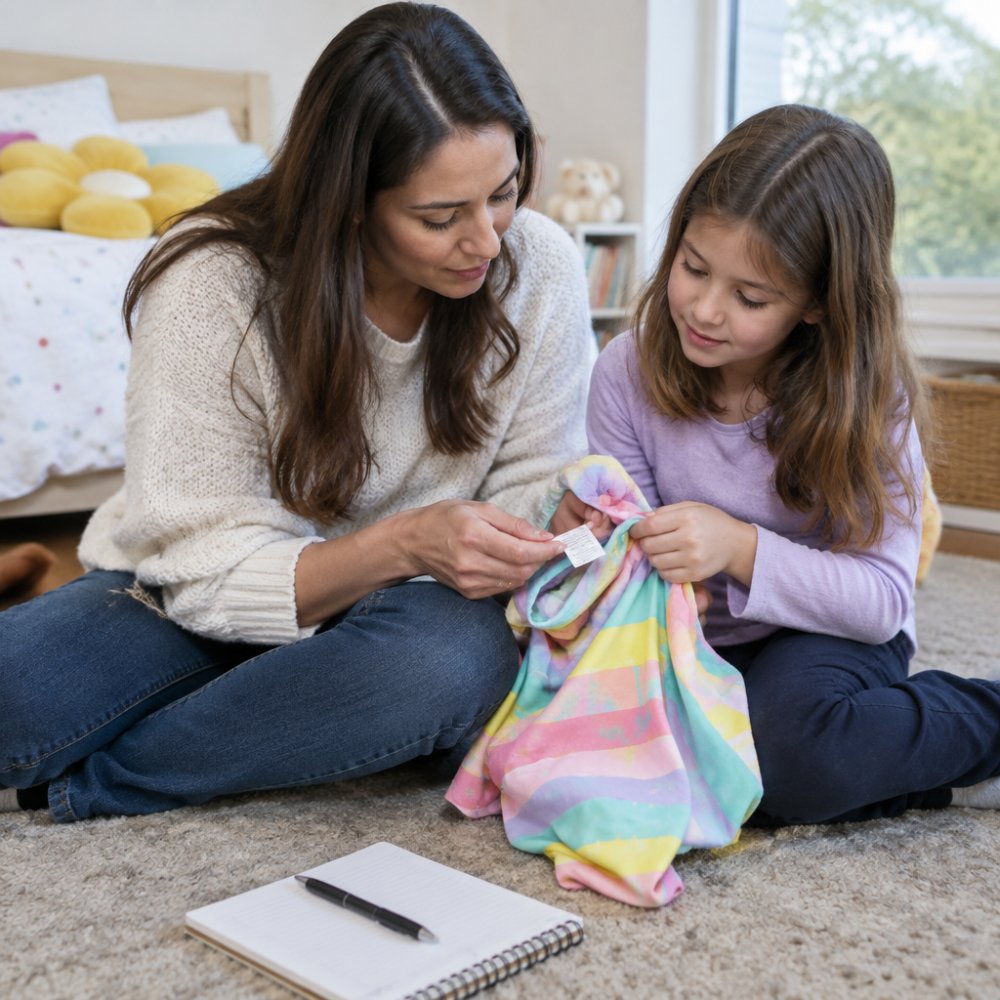
The five-question claim verification worksheet
Bring these five questions to any product page or store shelf:
- What exactly is claimed? Write the claim word for word. Vague wording is your first clue.
- Which part of the garment does it cover? The whole item, the main fabric, or just a trim?
- Is there a percentage? "60% organic cotton" is checkable. "Organic" alone is not.
- Is a certification named? A real certificate has a name and a body behind it.
- Does the brand explain the trade-off? Honest brands admit limits. They do not claim perfection.
If a claim fails three or more of these, treat it as marketing. You can still buy the item. Just do not pay extra for a story.
For a concrete example of a product that states its safety claim plainly, look at non-toxic kids nail polish. It shows how a clear claim reads next to a fuzzy one.
Clothing Sustainability Certifications: What They Cover and What They Don't
Clothing sustainability certifications are third-party programs that verify a specific thing, organic fiber content, restricted chemical use, recycled content, or fair labor, against a written standard. They do not certify a whole brand as "good." Each covers a narrow slice, usually narrower than the logo suggests.
That gap is where confusion grows: a certification mark feels like a gold star for the entire company, but it usually vouches for one material, one factory, or one process step.
The scope question: product, facility, or supply chain
Before you trust any logo, sort it into one of three buckets:
- Fiber or material certification. Covers the raw material, organically grown cotton or recycled polyester content, and says nothing about how the garment was sewn, dyed, or finished.
- Facility or process certification. Covers a factory or processing step, wastewater handling, chemical management, or energy use at that site, and says nothing about the fiber that entered or the garment that left.
- Product-level certification. Covers the finished item against a set of criteria. This is the broadest scope, and the rarest.
A single kids' t-shirt can carry a fiber certificate on the hangtag while the factory that dyed and sewed it has never been assessed. The certificate is not lying; it is answering a smaller question than the shopper is asking.
Programs you are likely to see on children's clothing
You do not need to memorize every standard. You need to know what each one actually checks. A few common ones:
- Global Organic Textile Standard (GOTS). Covers organic fiber content plus processing criteria, including chemical restrictions and wastewater treatment, across the textile supply chain. It is one of the broader textile standards, which is why it appears on finished garments rather than only on raw fiber.
- OEKO-TEX Standard 100. Tests finished articles for harmful substances against a published limit list. It is a product-safety test, not an organic or environmental-farming claim; a garment can pass it and still be made from conventional fiber.
- Global Recycled Standard (GRS). Verifies recycled content and adds social and environmental criteria at the processing stage. It speaks to the recycled percentage, not to durability or end-of-life.
A garment carrying two logos that answer two different questions, one for fiber, one for chemical safety, is not automatically greenwashing. It becomes misleading when the brand presents the pair as proof of overall sustainability.
How to actually verify a certificate
A logo on a hangtag can be copied onto products it was never issued for. The fix is a short verification routine:
- Get the certificate or license number. It is usually printed near the mark or listed on the product page. If the brand cannot produce one, treat the logo as decoration.
- Look it up on the certifying body's own site, not the brand's. Most standards publish a searchable database of valid certificate holders.
- Check the scope line. The database entry states what was certified, a material, a facility, or a product category, and often the valid-through date. Confirm it matches the claim you are reading.
- Check the dates. An expired certificate is not proof of anything current.
- Check the entity. The certificate may be held by a supplier or factory, not the brand on the tag. That is normal, but it means the brand is relying on a supplier's paperwork.
Watch out: a brand can hold a valid certificate for one product line and let the logo appear sitewide. The database entry will show the scope; the marketing page often will not.
What certifications do not tell you
Even a well-scoped certificate leaves most of the story untold. It generally does not tell you:
- how long the garment will last or whether it will pill after a few washes;
- whether the seams, tags, and closures suit a child with sensitive skin;
- how much the brand overproduces relative to what it sells;
Those are the questions a certificate cannot answer, and they matter most for kids' clothing. Use certifications to confirm a specific claim, then judge everything the certificate leaves out.
Star & Stripes Dress | Organic Cotton →
A useful starting point for how claims should be worded and backed is the Federal Trade Commission's Green Guides.
Each certification verifies a narrow slice of a garment's story, so it helps to know what each one actually checks.
| Certification | What it covers | Key limit |
|---|---|---|
| GOTS | Organic fiber content plus processing criteria, chemical restrictions, wastewater | One of the broader textile standards |
| OEKO-TEX Standard 100 | Tests finished articles for harmful substances | Product-safety test, not an organic claim |
| Global Recycled Standard (GRS) | Verifies recycled content, adds social and environmental criteria | Speaks to recycled percentage, not durability |
| bluesign | Chemical and resource management in manufacturing | Process standard about the factory, not the farm |
| Fair Trade Certified | Labor and sourcing conditions, worker premium | Social standard, does not certify fiber as organic |
What Organic Cotton Kids Clothing Labels Actually Promise
Organic cotton kids clothing labels promise one main thing: the cotton was grown without certain synthetic pesticides, following a defined standard.
The label does not promise the shirt is soft, safe for sensitive skin, or made in a fair factory.
So read the label in two layers. First, the fiber: what percentage is organic, and what is the rest? Second, everything else: seams, tags, closures, and care.
Here is a real example from our own shelves. The organic cotton kids lobster tee lists its fabric content and care right on the page, so you can check the claim instead of trusting a slogan.
Recycled fibers, bamboo, and the claims that get stretched
Recycled fibers are a genuine step forward, but the word "recycled" hides a range. A fabric can be partly recycled and partly new plastic.
Bamboo is where claims stretch the most. "Bamboo" sounds like a plant pulled from a garden.
If a bamboo item interests you, look for a page that states its fabric blend and care plainly, like our bamboo kids pajama set.

Reading a Garment's Whole Lifecycle, Not Just Its Label
A garment's environmental impact does not stop at the fiber. It runs from field to factory to your washing machine to the day it leaves your child's drawer. A label shows you the first step; the rest is invisible unless you go looking.
Here is the lifecycle view, in plain terms, with the stage that usually dominates:
- Growing or making the fiber. Water, land, and pesticide use for cotton; energy and feedstock for synthetic fiber. For conventional cotton, water and chemical inputs are the headline.
- Spinning, dyeing, and finishing. Energy and chemical use, and often the heaviest water pollution load. This is where a fiber certificate stops helping, because most fiber standards do not reach the dyehouse.
- Sewing and shipping. Manufacturing conditions and transport.
Why durability is the sustainability claim most brands skip
Wear life is a real environmental variable, not just a quality one.
Durability often comes down to a few concrete things you can inspect before buying:
- Fabric weight and construction. Thin single jersey stretches out and wears through faster than a denser knit. Heavier cotton and reinforced seams survive siblings better.
- Seam and hem construction. Look for double-stitched or reinforced seams at stress points, shoulders, knees, and the crotch on pants. A single row of stitching is the first thing to fail.
- Closure quality. Zippers, snaps, and buttons are common failure points. Metal snaps that pull through the fabric end a garment's life early.
Watch out: a brand can claim a low-impact fiber and a short wear life in the same product. The fiber claim gets marketed; the wear life determines the footprint.
The children's-clothing trade-offs no certification covers
Kids' clothing carries considerations that adult clothing does not, and they interact with sustainability claims in ways most guides ignore:
- Chemical safety versus "natural" fiber. A conventional cotton garment can be treated with finishes and dyes that a child's skin may react to; an OEKO-TEX Standard 100 test speaks to that, while an organic fiber claim does not. The two claims answer different questions, and a garment can have one without the other.
- Flame-resistance and sleepwear rules. If a brand markets a sleep garment as "chemical-free" and also as flame-resistant, ask how both are true at once.
- Small parts and attachment safety. A repairable garment with sewn-on buttons is both safer and longer-lived than one with glued trim.
Turning the lifecycle view into a buying question
You do not need a full life-cycle assessment to use this. Ask three questions at the shelf or on the product page:
- Which stage does this brand's claim actually address? If the claim is about fiber, the dyeing, washing, and disposal stages are still unaddressed.
- Will this survive a sibling and a hundred washes? Check fabric weight, seams, and closures. If the brand publishes care and construction details, that is a good sign it expects the garment to last.
- What happens at the end? A garment that can be handed down, repaired, or resold keeps its impact from being spent on one child.
The most sustainable kids' garment is usually the one worn hard, washed sensibly, and passed on, not the one with the longest list of green words on the tag.
Shopping Doodlebug's for Clothes You Can Actually Verify
At Doodlebug's Children's Boutique, we would rather show you the details than the slogans.
We focus on sensory-friendly, tag-less clothing made from organic and bamboo materials, soft seams, no scratchy tags, fabrics chosen for comfort.
A few items that state their materials clearly:
- The kids bamboo dress nightgown lists its fabric and care for easy checking.
- The bamboo toddler pajama set shows its blend right on the page.
Our advice is simple. Read the label. Check the percentage. Look for a named certification. Then buy the item your child will actually wear, wash, and hand down.


Frequently Asked Questions
What are some good ways to spot greenwashing in kids' fashion?
Start with the label. Look for specific fiber percentages rather than words like eco-friendly or natural, which have no legal definition. Then check whether a named third-party certification appears on the garment tag, not just in marketing copy. Finally, see if the brand publishes supply chain details such as country of origin and factory information. A brand that answers these three questions with specifics is far more trustworthy than one that relies on leafy imagery and vague promises.
Which sustainability claims on children's clothing should parents question most?
Question any claim without a number, a certification, or a named material. Phrases like planet-friendly, conscious collection, and made with sustainable materials tell you nothing verifiable. Also question brand-wide claims that a single product line supposedly fulfills. If a company says it diverts one pound of plastic per purchase, ask whether that applies to every item or only select styles. Specific, measurable statements hold up to scrutiny; vague ones usually do not.
What certifications can help verify environmental claims about clothing?
Look for third-party certifications with published standards, such as GOTS for organic textiles, OEKO-TEX Standard 100 for chemical safety testing, and Fair Trade Certified for labor practices. Each covers a specific scope, so a GOTS label confirms organic fiber processing but says nothing about fair wages. Read what the certification actually covers before treating it as proof of a brand's overall sustainability. Certifications help most when you match the seal to the exact claim being made.
How can you tell whether organic or bamboo kids' clothing is sustainably made?
Check the fiber percentage on the care label first. Organic cotton kids clothing should list a specific organic content, and a GOTS certification number adds verifiable proof. Bamboo is trickier: bamboo viscose involves heavy chemical processing, so the raw plant being natural does not make the finished fabric low-impact. Ask whether the brand discloses its manufacturing country and whether any chemical-safety certification covers the finished garment. Durability matters too, since clothes that survive repeated washing and hand-me-downs reduce waste.
Spotting greenwashing takes a few extra minutes, but it protects your wallet and rewards the brands doing real work. Doodlebug's Children's Boutique makes that easier with clear fabric details, tag-less designs, and organic and bamboo options built for comfort. Browse our sensory-friendly collection and shop clothes you can verify, one label at a time.
