Quick Summary
The best seamless socks for children with sensory issues have a true seam-free toe, meaning the toe is closed by linking loops rather than a sewn ridge. Turn the sock inside out and run a fingernail along the toe to check for a smooth, continuous closure before buying a multipack.
- Standard toe seams are the usual cause of refusal when toe pressure triggers a child.
- A flat-seam toe is thinner than a standard seam but can still be felt.
- Listings labeled seamless sometimes mean flat-seam, so check construction notes.
- Measure your child's foot in inches and add 1/4 to 1/2 inch of growing room.
- Bamboo viscose blends are a common choice for sensitive skin.
Table of Contents
- Why Seams Trigger Sensory Meltdowns in Children
- What Seamless Socks Actually Mean: Seam-Free vs. Flat-Seam
- Best Fabrics for Sensitive Skin in Kids' Socks
- Our Top Seamless Sock Picks, Compared by Fabric, Fit and Price
- Tips for Dressing Children with Tactile Sensitivity
- Sizing, Fit and Pressure: Avoiding Tight or Loose Socks
- Sensory-Friendly Clothing Beyond Socks: Building a Calm Wardrobe
- Start Your Child's Sock Switch with Doodlebug's This Week
- Frequently Asked Questions
Why Seams Trigger Sensory Meltdowns in Children
For many children with sensory processing differences, a single raised seam in a pair of seamless socks can turn a normal morning into a fight. Doodlebug's Children's Boutique offers sensory-friendly socks, and toe seams are a common concern for many families.
Seams matter because children with sensory sensitivity often notice pressure and texture that others barely register. A thick stitch line can feel like a pebble inside a shoe.
Sensory processing differences are common among autistic children, and many families report that clothing is one of the most frequent daily triggers. A American Occupational Therapy Association guidance on sensory processing describes how tactile input affects comfort and behavior, which is why small construction details carry so much weight.
Watch out: do not assume a sock is seamless because it is labeled soft. Check how the toe is closed and where the stitch sits before you buy a multipack.
What Seamless Socks Actually Mean: Seam-Free vs. Flat-Seam
"Seamless" gets used loosely, and the label alone will not tell you what your child will feel. There are three constructions sold under that word, and they behave differently against sensitive skin.
True seam-free (loop-linked or knitted-in toe). The sock is knit as a continuous tube and the toe is closed by linking loops rather than sewing a ridge. Run your finger across the inside of the toe and you should feel a smooth, flat closure with no raised line. This construction is often preferred by children who cannot tolerate a bump under the toes.
Flat-seam (flat-lock) toe. The toe is sewn, but the seam is pressed and stitched flat to reduce bulk. It is thinner than a standard overlock seam, but it is still a line you can feel. A flat seam may suit a child who minds only thick, lumpy stitching. Test it on a calm day before you buy a multipack.
Standard seam. A raised, sometimes bulky stitch line across the toes. This is the construction behind most "my child won't wear socks" complaints, and it is the one to avoid if toe pressure is the trigger.
How to inspect a sock before you buy
You do not need special equipment. Turn the sock inside out and use these checks:
- Run a fingernail along the inside of the toe. A true seam-free toe feels continuous. A flat seam feels like a thin cord. A standard seam feels like a ridge.
- Look at where the closure sits. A seam placed high on the toes rubs against the nail bed; one set back from the toe tips is less noticeable.
- Stretch the toe gently. A closure that bunches or puckers when stretched will bunch against the foot.
- Check the cuff and heel too. A bulky toe gets the blame, but a tight cuff or a lumpy heel can trigger the same refusal.
- Read the construction notes, not the marketing word. Listings that say "seamless" sometimes mean flat-seam. Look for language such as "loop-linked toe," "hand-linked toe," or "no toe seam."
What changes after washing
Watch out: do not assume a sock is seamless because it is labeled soft or because the outside looks smooth. The seam is on the inside, and that is where your child's toes will feel it.
Best Fabrics for Sensitive Skin in Kids' Socks
Fabric changes how a sock feels as much as construction does. Bamboo viscose is a common choice for sensitive skin because it is smooth and breathable. Synthetic blends with a little spandex hold shape well but can feel scratchier against some skin.
Our knee-high set is 72% bamboo viscose, 26% nylon and 2% spandex. Our character styles are 88% polyester, 10% nylon and 2% spandex. Neither is the right answer for every child, so match the fabric to how your child reacts to touch.
Our Top Seamless Sock Picks, Compared by Fabric, Fit and Price
Here is how we would choose among our current options. Fit is listed for children's sizing where the listing provides it.
| Sock | Fabric | Fit | Price (USD) |
|---|---|---|---|
| Knee-High Socks Set, Snow and Heron | 72% bamboo viscose, 26% nylon, 2% spandex | True to size | $5.00 |
| Character Kids Socks (Robot, Dolphin, Hearts, Unicorn and more) | 88% polyester, 10% nylon, 2% spandex | Sock size 6-8.5, approx. age 5 to 10 | $7.99 |
Knee-High Socks Set, Snow and Heron ($5.00)
This set includes two knee-high socks in a bamboo viscose blend that the listing describes as lightweight and ultra-soft. At $5.00, it is the lowest-priced option here. [Product page: Knee-High Socks Set, Snow and Heron | shopdoodlebugsboutique.com]
Knee-High Socks Set- SNOW AND HERON →

Character Kids Socks, Robot, Dolphin, Hearts, Unicorn and More ($7.99)
The character range includes a polyester-nylon-spandex blend that is machine washed warm. Fit is listed for sock size 6-8.5, approximately ages 5 to 10. [Product page: Robot Kids Socks | shopdoodlebugsboutique.com]
Tips for Dressing Children with Tactile Sensitivity
Let your child choose from two or three socks the night before, so the morning is not a negotiation. Turn socks inside out to check the toe seam before putting them on. Introduce a new sock on a weekend first, when there is no rush and you can see how it feels over a few hours.
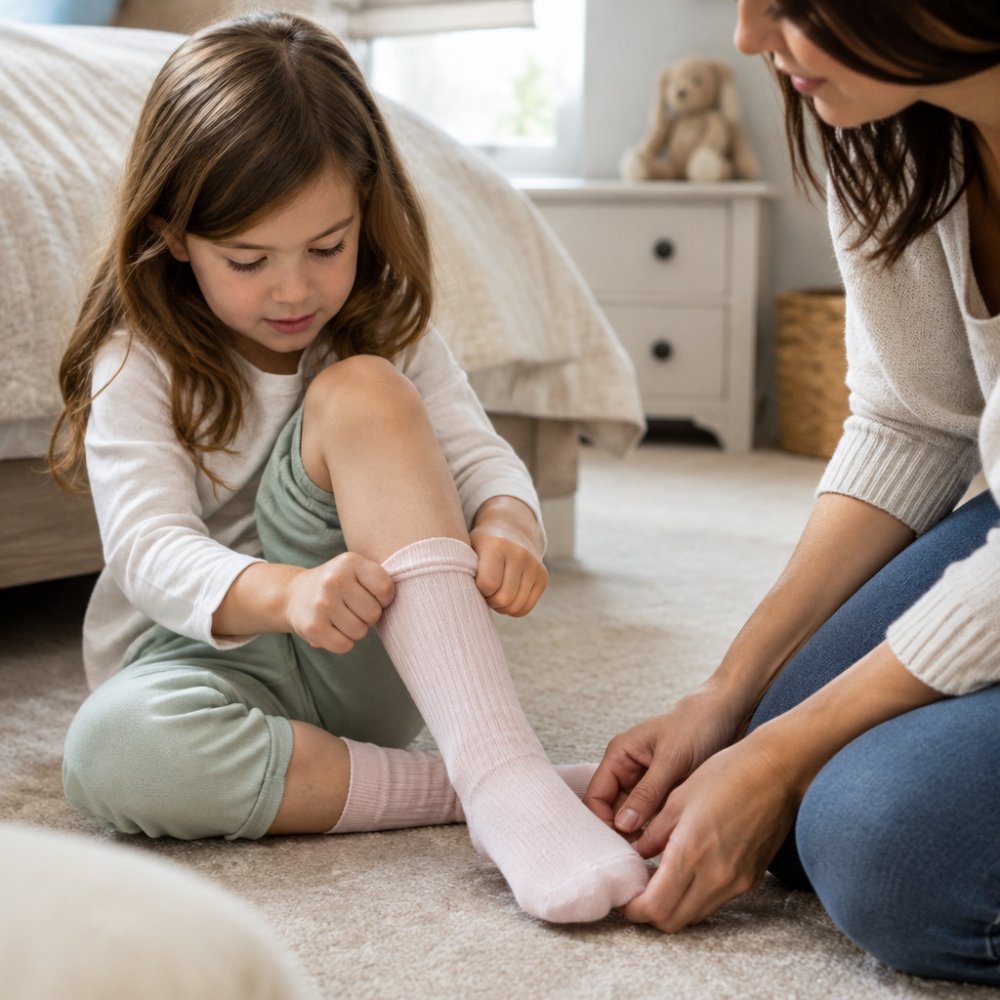
Keep a short routine: sock, then shoe, with the same order every day. Predictability reduces stress for many children. Small, consistent changes tend to work better than switching everything at once.
Sizing, Fit and Pressure: Avoiding Tight or Loose Socks
A sock that is too tight creates pressure, and pressure can be as distracting as a seam. A sock that slides down bunches under the foot and between the toes. Fit is the second half of the sensory equation, and it is the part most product listings leave out.
Measure the foot, not the age
Sock sizes are usually given as a range (for example, sock size 6-8.5), and age ranges are only a rough guide because children's feet vary widely. Measure at home:
- Have your child stand on a sheet of paper with weight on both feet.
- Mark the tip of the longest toe and the back of the heel.
- Measure the distance in inches. Measure both feet, because one is often slightly longer.
- Add about 1/4 to 1/2 inch of growing room, then compare that total to the sock's stated foot length or size range.
If the listing gives only a sock size, ask the seller for the foot length in inches that corresponds to it. A sock that matches the foot length is more reliable than one chosen by age.
Signs a sock is too tight
- A red mark or indentation on the ankle or calf that is still visible an hour after the sock comes off.
- The child pulls at the cuff, tugs the toe, or takes the sock off as soon as they can.
- Toe tips look compressed, or the heel sits forward of the actual heel.
- The sock leaves a ridge line across the top of the foot where the shoe presses down.
Signs a sock is too loose
- The heel bag sags below the ankle or rides up above it.
- Fabric bunches under the arch or between the toes when the shoe goes on.
- The sock twists around the foot during the day.
- The child walks on the sock and it slides off at the heel.
Growth, between sizes, and the shoe interface
When a child is between sizes, the larger size is usually the more comfortable choice for sensory-sensitive feet, provided the cuff still fits snugly enough to stay up. Buy one pair in the new size and test it inside the actual school shoe before replacing the drawer, because a sock that feels fine barefoot can bunch once a shoe is on. Check fit every few months; children's feet can grow a half size or more in a season, and a sock that fit in the fall may press by spring.
Watch out: do not size up more than about half an inch of growing room. An oversized sock bunches at the heel and toe, and bunching can feel just as irritating as a tight band.
Sensory-Friendly Clothing Beyond Socks: Building a Calm Wardrobe
Socks are only one layer. Many families find that tags, waistbands and fasteners matter just as much. Choose tagless designs where possible, and look for soft fabrics against the skin across the whole outfit.
Build the wardrobe gradually. Start with the items your child wears most often, such as socks and everyday tops, and add pieces as you learn what works. Keep notes on which fabrics and fits your child tolerates well.
Start Your Child's Sock Switch with Doodlebug's This Week
Start with one pair, try it at home on a calm day, and build from there. Browse the Doodlebug's Children's Boutique range and pick one option to test this week.
Frequently Asked Questions
Are seamless socks worth the extra cost?
For many families, yes. The Doodlebug's socks in this guide run from $5.00 to $7.99 per pair. Start with one or two pairs in the style your child already likes before buying a full set.
What makes a sock sensory-friendly?
A sensory-friendly sock usually has no raised seam across the toes, a soft and lightweight knit, and enough stretch to fit without squeezing. Many children with sensory processing differences also react to thick cuffs and tight bands. The Knee-High Socks Set from Doodlebug's is made of 72% bamboo viscose, 26% nylon and 2% spandex, which gives a soft, breathable feel. Check the fabric content, the toe construction and the cuff before buying.
Why do children with sensory issues struggle with sock seams?
Children with heightened tactile sensitivity can feel a small ridge of stitching that most adults never notice. Once that feeling is noticed, it can dominate attention during the day and make putting on shoes unbearable. A seam that sits against the toe or the sole is often the trigger. Removing the seam, or choosing a sock with a flat, low-profile toe, usually reduces the complaint.
Can seamless socks help reduce morning dressing meltdowns?
Putting socks on a child before the rest of the outfit, and offering a choice between two or three familiar styles, is one approach families use. Doodlebug's Robot, Dolphin, Hearts, Unicorn, Bacon & Eggs, Firemen, Mac 'n Cheese, Flamingo and Hockey Kids Socks each fit ages 5 to 10 in sock sizes 6 to 8.5. Keep a backup pair ready so one scratchy sock does not derail the whole morning.
