
Table of Contents
- Why New Clothing Textures Feel Threatening to Sensory Sensitive Children
- Sensory Processing Disorder vs ADHD Symptoms in Kids: What Parents Should Know
- What You'll Need Before You Start
- Step 1: Identify Your Child's Clothing Triggers and Comfort Zone
- Step 2: How To Desensitize Sensory Issues With Clothing Through Gradual Exposure
- Step 3: The Best Fabrics for Sensory Sensitive Children
- Step 4: Try DIY Sensory Modification Before You Buy
- Step 5: Make New Textures Stick Through Laundry and Routine
- Frequently Asked Questions
Last Updated: September 30, 2026
Why New Clothing Textures Feel Threatening to Sensory Sensitive Children
A tag brushing the back of the neck can feel like a bug bite to a child with tactile defensiveness. That is not drama. It is how their nervous system reads the input.
Sensory Processing Disorder vs ADHD Symptoms in Kids: What Parents Should Know
Sensory processing disorder and ADHD can look similar on the surface, but they stem from different root causes. SPD affects how the brain interprets sensory input; ADHD affects attention, impulse control, and self-regulation. Some children have both. A child who rips off a sweater may be reacting to texture; a child who cannot sit still for socks may be seeking movement.
Here is a quick comparison:
| Trait | Sensory Processing Disorder | ADHD |
|---|---|---|
| Main issue | Brain misreads touch, sound, movement | Brain struggles with focus and impulse |
| Clothing reaction | Avoids or craves textures | Restlessness, fidgeting with clothes |
| Trigger | Specific fabrics, seams, tags | Boredom, sitting still too long |
| Best first step | Occupational therapy evaluation | Pediatric evaluation |
What You'll Need Before You Start
Gather these items before you introduce anything new. Preparation cuts down on meltdowns.
- A few fabric swatches in different textures (soft cotton, bamboo, fleece)
- One new clothing item in a single new texture
- A quiet, low-stimulation space
- A timer or clock
- A favorite comfort item
- A small reward your child chooses
Step 1: Identify Your Child's Clothing Triggers and Comfort Zone
The first step is simple observation. Watch what your child already wears without complaint. That is their comfort zone.
Common clothing triggers for tactile avoidance include:
- Tags at the neck or waist
- Thick seams inside socks
- Rough or stiff fabric
- Tight waistbands
- Buttons, zippers, and snaps
- Clothing that shifts or bunches
Step 2: How To Desensitize Sensory Issues With Clothing Through Gradual Exposure
The graded contact ladder
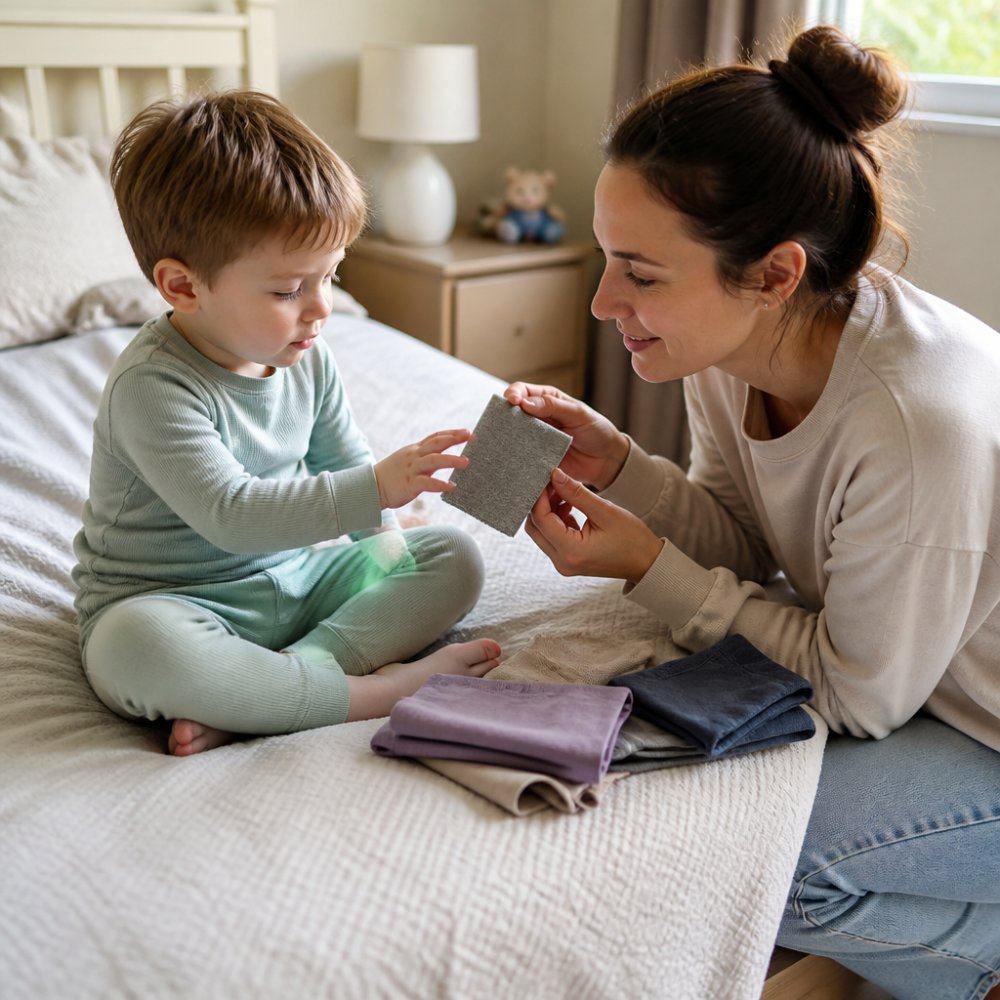
Start with the fabric off the body, then move inward only when your child is calm and willing. Each rung should feel almost too easy before moving to the next.
- Visual, Place the fabric swatch on a table where your child can see it. No touching. Let them look while doing something else.
- Fingertip, Ask them to tap it with one finger for about five seconds. Fingertips are less sensitive than palms, so this is a gentler entry point.
- Palm, Rest the swatch in their open hand for 10 to 15 seconds.
- Forearm, Lay it across the forearm for 30 seconds. The forearm is a common "safe" zone for many kids.
- Shoulder or back, Drape it over the shoulder or lay it across the upper back for one minute.
- Garment, worn briefly, Put the actual item on for two minutes, then take it off on a positive note.
- Garment, extended, Add two to three minutes per session, every few days.
Reading your child's stop signals
Stop the moment you see distress, not the moment you hear a complaint. Early signals are physical and easy to miss: stiffening shoulders, holding the breath, pulling the fabric away with two fingers, going quiet, or suddenly asking for a drink or bathroom break. Pushing past that point teaches the brain the texture predicts something bad, which can set tolerance back by weeks.
How long this actually takes
Most practitioners find a single new texture takes two to six weeks of short, frequent sessions before it becomes wearable for a full day; stiff denim, wool, and raised seams can take longer. Progress is rarely linear, a texture tolerated on Tuesday may be unbearable on Thursday because of sleep, hunger, or a hard day at school. That is normal variation, not failure.
When a rung fails
If your child refuses a step two sessions in a row, drop back one rung for several days rather than skipping ahead. If the garment itself is the problem, separate texture from fit, try the fabric as a loose scarf or pillowcase first, so the child processes one new sensation at a time.
Step 3: The Best Fabrics for Sensory Sensitive Children
There is no single "best" fabric, because sensory sensitivity is not one thing. A child who craves deep pressure may love a snug stretchy knit, while a child with tactile avoidance finds that same knit suffocating. What matters is matching the fabric's properties to your child's profile.
The four properties that decide whether a fabric works
- Surface smoothness, How much friction the fiber creates against skin. Smooth fibers (bamboo, modal, fine cotton) glide; rougher ones (wool, linen, coarse denim) drag.
- Weave and knit density, Tight, flat weaves feel predictable; loose knits and waffle textures create small bumps some kids register as constant irritation.
- Stretch and recovery, Two-way stretch moves with the body and reduces shifting; fabrics that bag or bunch create unpredictable contact.
- Moisture and temperature behavior, A fabric that traps sweat changes texture within minutes, turning a tolerable shirt into an intolerable one by mid-morning.
Fiber-by-fiber breakdown
- Bamboo (viscose from bamboo), Silky, cool, and smooth. Good for warm sleepers and kids who hate friction. Trade-off: it can pill, and pilled fabric feels rougher.
- Organic cotton, Soft, breathable, and predictable, the most reliable starting point for most kids. Trade-off: standard cotton can feel stiff until washed several times.
- Modal and lyocell, Plant-based, very smooth, often blended with cotton or spandex. Excellent for sensory-seeking kids who want a snug, cool feel. Trade-off: some kids dislike the slick, cool sensation.
- Spandex blends (cotton/spandex, bamboo/spandex), Add stretch and recovery, reducing bunching; 5 to 10 percent is usually enough. Trade-off: too much can feel tight or clammy.
- Fleece, Soft and warm, often a favorite for kids who seek deep pressure. Trade-off: it runs hot, and overheating can trigger a meltdown that looks like a texture problem.
- Merino wool (fine-gauge), Unlike coarse wool, fine merino can be soft enough for some sensitive kids and regulates temperature well. Trade-off: expensive and still a gamble for strong tactile avoidance.
What to avoid at first
Stiff denim, coarse wool, linen, and anything with a raised or exposed seam. These are not permanent bans, they are textures to introduce later, once tolerance for easier fabrics is established.
Why blends and weaves matter more than fiber names
A 100 percent cotton shirt with a rough weave can feel worse than a cotton/polyester blend with a smooth finish. Turn a garment inside out and run the back of your hand along the inside seam, that surface, not the outside, is what your child's skin feels all day.
The laundry factor most guides skip
Doodlebug's Children's Boutique carries tag-less apparel made from organic and bamboo materials, which removes one of the biggest triggers before a child even puts the item on.
Step 4: Try DIY Sensory Modification Before You Buy
Before buying new clothes, try fixing what you already own. DIY sensory modification saves money and teaches you what your child actually needs.
Quick fixes that work:
- Cut tags out completely, not just partway
- Iron a soft cotton patch over an itchy seam
- Turn socks inside out so the toe seam faces out
- Add a soft fabric band inside a waistband
- Swap buttons for elastic or magnetic closures
- Wash stiff fabric with fabric softener to soften it
Step 5: Make New Textures Stick Through Laundry and Routine
New textures only stick if they stay comfortable after washing, so laundry and maintenance matter more than most parents expect. Wash new items before wearing to soften fabric and remove factory stiffness, use a gentle fragrance-free detergent, and skip fabric softener if your child is sensitive to scent.
Build texture into the dressing routine:
- Lay out clothes the night before
- Let your child choose between two safe options
- Keep the order the same every morning
- Use a visual checklist for younger kids
Frequently Asked Questions
How do you desensitize a child to clothing textures?
Start with brief, low-pressure contact. Let your child touch the new fabric for a few seconds during play, then put it away. Over days, increase contact time and move from touching to draping it on an arm, then wearing it for short periods at home. Pair each step with a preferred activity so the nervous system links the texture to something calm. Rushing the sequence usually backfires; slow, repeated exposure is what builds tolerance.
What kind of clothing is best for children with sensory processing disorder?
Soft natural fibers like cotton, bamboo, and modal tend to work well because they feel smooth against skin and breathe. Look for tag-less designs, flat seams, and covered elastic waistbands. Compression layers made with lycra or spandex can help some children feel grounded through proprioceptive input. The right choice depends on your child's sensory profile: a texture-avoider needs smooth and seamless, while a sensory-seeker may prefer snug, weighted, or textured options.
Can sensory clothing sensitivity improve over time?
Yes, for many children it does. The nervous system adapts with repeated, positive exposure, and tolerance often grows as kids get older and learn self-regulation skills. Progress is rarely linear, so expect good days and hard days. Keep new textures in rotation even after success, because familiarity fades if a fabric disappears from the wardrobe for months.
Do ADHD kids have sensory issues with clothes?
Many do. ADHD and sensory processing differences often overlap, and children with ADHD may be more easily distracted or irritated by tags, seams, and scratchy fabrics. The symptoms can look similar to sensory processing disorder, which is why an evaluation by an occupational therapist helps clarify what is driving the reaction. In practice, the fix is often the same: reduce triggers with tag-less, soft clothing and build tolerance gradually.