
Table of Contents
- Sensory Overload vs. Sensory Seeking: Know the Difference First
-
Best Calming Sensory Tools for Autism: Our Top Picks
- 1. Happy Hugs Weighted Plush Bulldog, Deep Pressure on Demand
- 2. Wiggle Wobble Rock & Twist, Vestibular Input for Sensory Seekers
- 3. Sit & Twist Active Seat Cushion, Movement While Sitting
- 4. Calming Stretchy Band Fidget Toy, Quiet Focus Tool
- 5. Thingamajig Sensory Pillow, Tactile Exploration for Little Hands
- 6. Rainbow Push-Pop-It Bubble Fidget Toy, Budget-Friendly Tactile Relief
- 7. Glo Pals Sensory Jars, Visual Calming Aids
- 8. Creatures Full of Feelings Card Game, Emotional Regulation Through Play
- Sensory Toys for Kids: How to Match the Tool to the Need
- Occupational Therapy Sensory Tools: What OTs Actually Recommend
- Sensory-Friendly Clothing for Autism: The Missing Piece
- Calming Sensory Tools in the Classroom and at Home
- Conclusion
Last Updated: August 21, 2026
Finding the right calming sensory tools for autism is challenging when every child's sensory profile differs. At Doodlebug's Children's Boutique, we've curated tools that genuinely support children with sensory processing disorder, ADHD, and autism. This guide matches specific sensory needs to specific solutions.
Quick Picks:
- Best Deep Pressure Tool: Happy Hugs Weighted Plush Bulldog, lap-ready weighted comfort for anxiety relief
- Best for Sensory Seekers: Wiggle Wobble Rock & Twist, full vestibular and proprioceptive input
- Best Classroom Tool: Sit & Twist Active Seat Cushion, silent movement that doesn't disrupt others
- Best Budget Pick: Rainbow Push-Pop-It Bubble Fidget Toy, tactile relief for $5.99
Sensory Overload vs. Sensory Seeking: Know the Difference First
The key question isn't "What will calm my child down?" but rather: is your child overwhelmed by too much sensory input, or are they desperately seeking more of it?

Sensory overload occurs when the nervous system receives more input than it can process. Children may cover their ears, avoid bright lights, refuse certain textures, or melt down in crowded spaces. The goal is to reduce or filter stimulation.
Sensory seeking looks opposite. These children crave proprioceptive input, vestibular movement, and tactile feedback. They spin, crash into furniture, and can't sit still. The goal is to provide enough sensory input to satisfy the nervous system.
This distinction matters enormously for tool selection. A weighted blanket works well for an overloaded child but may frustrate a sensory seeker who needs active movement. According to the STAR Institute for Sensory Processing, children with sensory processing disorder can present as over-responsive, under-responsive, or sensory seeking, often a combination depending on environment and time of day.
Best Calming Sensory Tools for Autism: Our Top Picks
The tools below address different sensory needs across the overload-seeking spectrum.
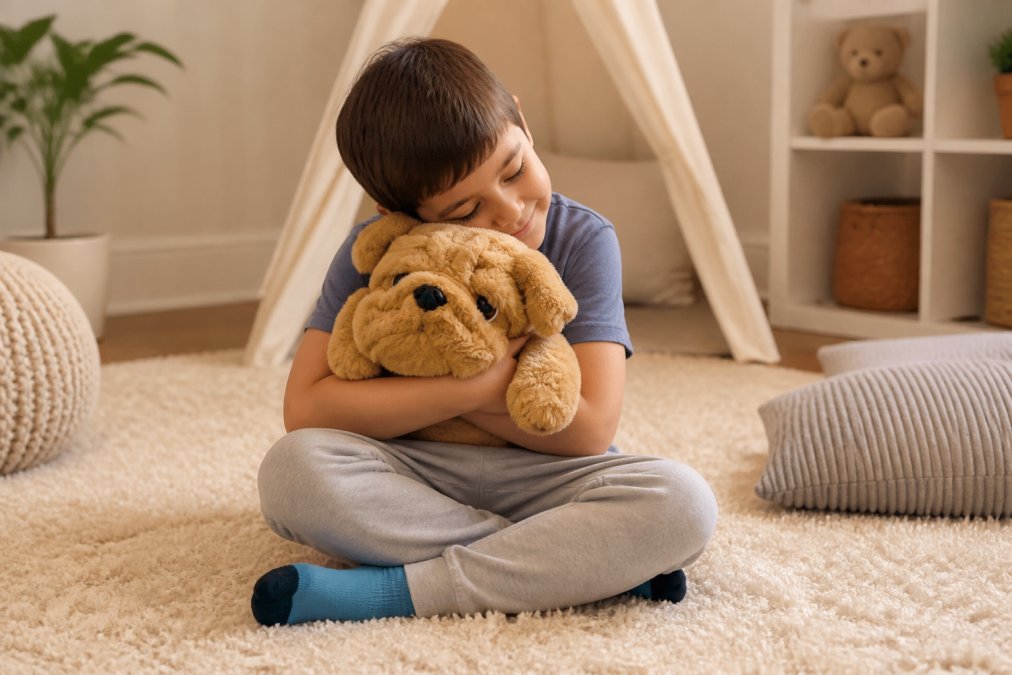
1. Happy Hugs Weighted Plush Bulldog, Deep Pressure on Demand
Best for: Children who need deep pressure stimulation for anxiety management without the bulk of a full weighted blanket.
The Happy Hugs Weighted Plush Bulldog ($49.99) is a practical deep pressure tool for young children. At 2.5 lbs and 15x12x5 inches, it rests on a lap, stomach, or chest, exactly where deep pressure stimulation is most effective for calming the nervous system. The combination of weight and tactile feedback from high-pile plush with wrinkle ridges provides both proprioceptive and tactile input that helps children feel grounded and secure. The removable weighted bag makes the outer plush machine washable for daily use. It's safety tested for ages 3 and up.
Where it shines: Circle time, car trips, transitions, and bedtime wind-down.
2. Wiggle Wobble Rock & Twist, Vestibular Input for Sensory Seekers
The Wiggle Wobble Rock & Twist ($69.99) features 360-degree tilting rotation supporting front-to-back and side-to-side balance movement, stimulating the vestibular system in ways passive tools cannot. Spinning and rocking expel excess energy, the core mechanism behind movement-based calming for sensory seekers. Built with thick plastic and foam-rubber-covered steel handles, it supports up to 300 lbs and grows with the child. Four-way balance work improves posture, coordination, and cognitive development alongside sensory regulation.
Limitation: It requires floor space and isn't portable, a home or therapy room tool only.
3. Sit & Twist Active Seat Cushion, Movement While Sitting
The biggest classroom mistake is expecting a child who needs vestibular input to sit completely still. The Sit & Twist Active Seat Cushion ($29.99) solves this elegantly. The patent-pending 120-degree rotating pivot disc spins like a lazy Susan, letting children twist silently while seated. For children with ADD, ADHD, or autism who can't sit still, this provides continuous movement needed to focus without classroom disruption. At 12 inches in diameter with a 300 lb weight limit, it fits most standard chairs and the heavy-duty vinyl surface wipes clean easily.
4. Calming Stretchy Band Fidget Toy, Quiet Focus Tool
The Calming Stretchy Band Fidget Toy ($14.99) is what occupational therapists actually reach for when a child needs a silent, discreet focus tool. The band measures 30 inches by 6 inches at rest and stretches to over 46 inches. Pulling, bending, twisting, and knotting provide proprioceptive input through the hands and arms, promoting calm without visual distraction. It redirects oral motor seeking behavior (chewing on clothing or pencils) into hand-based proprioceptive input, reducing the behavior meaningfully.
5. Thingamajig Sensory Pillow, Tactile Exploration for Little Hands
The Thingamajig Sensory Pillow ($24.99) is an occupational therapy tool disguised as a toy. The pillow features straps, zippers, buttons, cord, and buckles, each providing different tactile experiences and fine motor challenges. At 7x5.5x2.5 inches, it fits in a backpack and operates silently, working at school, religious settings, and during car trips. Varied textures keep engagement higher longer than single-texture tools.

6. Rainbow Push-Pop-It Bubble Fidget Toy, Budget-Friendly Tactile Relief
At $5.99, the Rainbow Push-Pop-It Bubble Fidget Toy is the most accessible calming sensory tool on this list. The push-pop mechanism provides repetitive tactile feedback with each bubble press, supporting self-soothing through predictable, satisfying sensory input. The rainbow dye design adds visual stimulation: watching colors swirl is genuinely calming for children who respond to visual input. This is the right starting point for parents unsure whether their child will respond to fidget tools.
7. Glo Pals Sensory Jars, Visual Calming Aids
Visual calming aids are underused in sensory toolkits. The Glo Pals Sensory Jars ($21.99 each) fill that gap. Available in Teal, Blue, and Coral, these water-activated light jars create glowing, color-shifting displays that draw visual attention and encourage calm, focused states. The Teal Sensory Jar blends soothing blue and green, the Blue Sensory Jar uses ocean-inspired glow ideal for bedtime, and the Coral Sensory Jar offers bolder stimulation for children craving more visual excitement. All are durable, reusable, and spill-proof with locking lids. Requires 3 AAA batteries (not included).
8. Creatures Full of Feelings Card Game, Emotional Regulation Through Play
Emotional regulation is the long-term goal behind every calming sensory tool. The Creatures Full of Feelings Card Game ($21.99) addresses that goal directly through therapeutic play. Grounded in play therapy principles, the 52-card deck helps children identify emotions through body language and expression, practice emotional vocabulary, and understand others' feelings. For neurodivergent children who struggle to name and communicate emotional states, this card game builds vocabulary that makes other calming strategies more effective.
Sensory Toys for Kids: How to Match the Tool to the Need
Choosing sensory toys without a diagnostic framework leads to unused tools. The table below maps common sensory presentations to matching tools.
| Sensory Presentation | Best Tool Match | Why It Works |
|---|---|---|
| Anxiety, needs comfort | Happy Hugs Weighted Bulldog | Deep pressure stimulation reduces cortisol response |
| Can't sit still, seeks movement | Wiggle Wobble Rock & Twist | Vestibular input satisfies movement craving |
| Fidgets in class, disrupts others | Sit & Twist Cushion + Stretchy Band | Silent proprioceptive input channels energy |
| Chews clothing, seeks oral input | Stretchy Band Fidget Toy | Redirects to hand-based proprioceptive input |
| Needs tactile exploration | Thingamajig Sensory Pillow | Varied textures for structured touch |
| Visual calming needed | Glo Pals Sensory Jars | Focused visual stimulation promotes calm |
| Emotional dysregulation | Creatures Full of Feelings Cards | Builds emotional vocabulary and regulation |
| Budget-limited, testing fidgets | Rainbow Push-Pop-It | Low-cost entry point for tactile feedback |
The most common mistake is buying tools based on appearance rather than specific sensory need. A sensory seeker given a weighted blanket may find it restrictive. An overloaded child given a vibrating fidget may escalate. According to the American Occupational Therapy Association's sensory processing resources, a sensory diet, a personalized activity plan providing the right type and amount of sensory input throughout the day, is far more effective than any single tool used in isolation.
Occupational Therapy Sensory Tools: What OTs Actually Recommend
Occupational therapy sensory tools are most effective as part of a structured sensory diet rather than used reactively during meltdowns. OTs organize sensory input into three categories: alerting (increases arousal), organizing (regulates arousal), and calming (decreases arousal).
Alerting tools are appropriate when a child is lethargic. Vestibular movement, bright visual stimulation, and resistive activities wake the nervous system.
Organizing tools provide steady, rhythmic input helping the nervous system find baseline. Rocking, rhythmic bouncing, and repetitive tactile activities like the Stretchy Band serve this function.

Calming tools reduce arousal for overloaded children. Deep pressure from the weighted bulldog, slow visual stimulation from Glo Pals jars, and quiet tactile play with the Thingamajig Pillow all serve this function.
The Sensory Processing Disorder Foundation's guidance on sensory diets emphasizes that timing and sequence of sensory input matters as much as the tools themselves.
Sensory-Friendly Clothing for Autism: The Missing Piece
The most overlooked element in any sensory toolkit is clothing. A child in sensory-unfriendly clothing fights constant tactile friction before any toy can help. Tags, seams, tight waistbands, and synthetic fabrics create continuous feedback that depletes regulatory capacity throughout the day.
Sensory-friendly clothing for autism eliminates these friction points: tag-less construction, flat or minimal seams, soft organic or bamboo materials, and elastic waistbands instead of buttons or snaps. Doodlebug's Children's Boutique specializes in this category with tag-less apparel made from organic and bamboo materials chosen for softness, breathability, and gentleness against sensitive skin. A child dressed comfortably arrives at school with more regulatory capacity available for learning.
Calming Sensory Tools in the Classroom and at Home
Sensory tools are most effective when available consistently across environments. A child with access to calming tools at home but not at school manages two entirely different regulatory experiences daily.
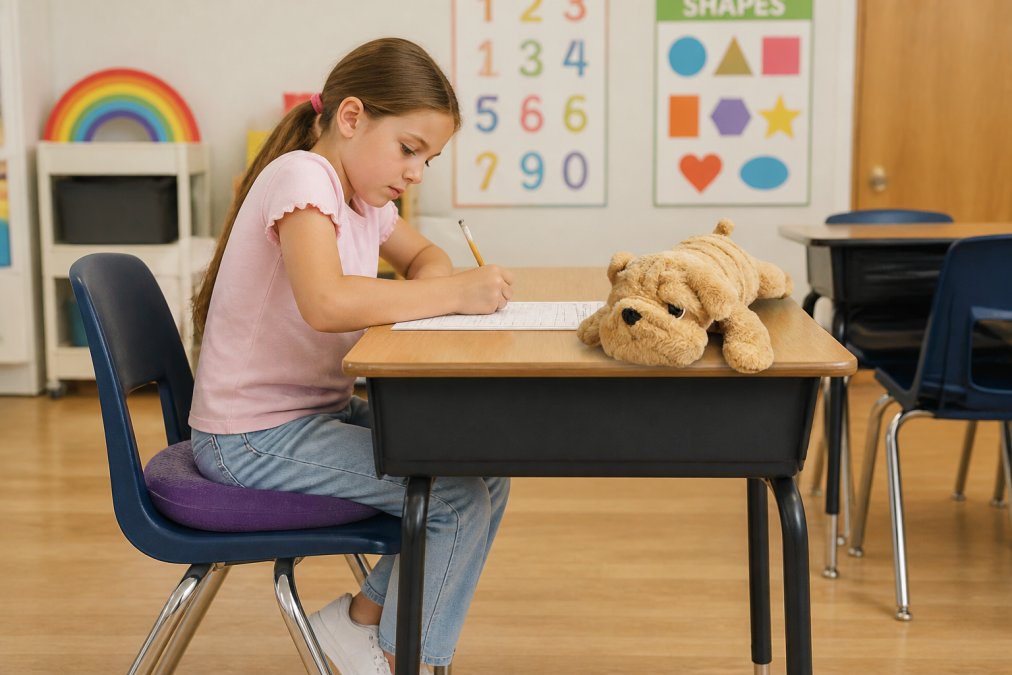
Most tools on this list are designed for dual-environment use: the Sit & Twist Cushion, Stretchy Band, and Thingamajig Pillow are portable, silent, and unobtrusive enough for classroom use without singling a child out. For school integration, the IDEA (Individuals with Disabilities Education Act) provisions on assistive technology support including sensory tools in IEP accommodations. Parents can formally request specific sensory tools be documented as part of a child's educational support plan, ensuring consistency across teachers and classrooms.
At home, sensory tools work best when organized and accessible. A dedicated "calm-down corner", a physical space with the child's preferred tools, gives children a place to self-regulate before reaching meltdown.
Budget-Friendly DIY Alternatives
Several effective sensory tools can be made at home with minimal cost:
- DIY sensory bottle: Fill a clear plastic bottle with water, glitter glue, and small beads. Seal with waterproof adhesive. Shaking and watching glitter settle provides visual calming.
- Homemade weighted lap pad: Sew a fabric pouch and fill with dried rice or plastic pellets. A lap pad weighing roughly 10% of body weight provides meaningful deep pressure.
- Textured sensory bin: Fill a shallow container with dried beans, kinetic sand, or rice. Supervised tactile exploration provides proprioceptive input and fine motor development.
DIY options work well as starting points or supplements. Commercial tools are typically more durable, safety-tested, and portable for everyday and school use.
Hygiene and Maintenance Tips
Sensory tools used daily need regular cleaning.
| Tool | Cleaning Method | Frequency |
|---|---|---|
| Happy Hugs Bulldog | Machine wash outer plush; air dry weighted bag | Weekly |
| Sit & Twist Cushion | Wipe with damp cloth and mild soap | After each school day |
| Stretchy Band | Gentle machine wash, air dry | Weekly |
| Push-Pop-It | Hand wash with soap and water | Every 2-3 days |
| Glo Pals Sensory Jar | Wipe exterior only | Weekly |
| Thingamajig Pillow | Spot clean fabric; wipe fasteners | Weekly |
Finding the right calming sensory tools for autism takes trial, observation, and patience. Doodlebug's Children's Boutique carries a curated selection of sensory toys for kids, from the $5.99 Rainbow Push-Pop-It to the $69.99 Wiggle Wobble Rock & Twist, alongside sensory-friendly clothing designed to reduce constant tactile friction that depletes regulatory capacity. Browse the full collection and find tools matched to your child's specific sensory profile.
Frequently Asked Questions
What are some good calming tools for autistic kids?
Weighted plush animals, fidget bands, wobble cushions, and sensory jars are among the most effective calming sensory tools for autism. Each targets a different sensory channel: weighted items provide deep pressure stimulation, fidget tools give tactile feedback for focus, wobble seats deliver vestibular input, and glowing sensory jars offer visual calming. The right choice depends on whether your child is sensory seeking or experiencing sensory overload. Starting with one low-cost option like a push-pop fidget toy lets you test what resonates before investing in larger items.
How do sensory tools help with autism-related overstimulation?
Sensory tools work by giving the nervous system an alternative, controlled input that competes with overwhelming environmental stimuli. A weighted blanket or plush, for example, applies gentle deep pressure stimulation that activates the parasympathetic nervous system, slowing the stress response. Fidget toys redirect repetitive behaviors into a productive outlet, while visual aids like sensory jars give the eyes a calm focal point. Occupational therapists often build these tools into a child's sensory diet so the nervous system gets regular, predictable input throughout the day.
Are there specific sensory tools recommended by occupational therapists?
Occupational therapists commonly recommend tools that address proprioceptive input, vestibular system regulation, and tactile feedback, the three sensory channels most often dysregulated in children with sensory processing disorder or autism. Weighted items (2 to 3 lbs for lap pads or plush), wobble seats, and chewy or stretchy fidget tools appear frequently in OT-designed sensory diets. Tools that are silent and portable, like a stretchy band fidget toy, are especially valued for classroom use because they support focus without disrupting other students.
How can sensory-friendly clothing complement calming tools?
Sensory-friendly clothing for autism removes a constant source of background irritation, scratchy tags, tight seams, and rough fabrics, that can push a child closer to sensory overload before the school day even begins. When clothing stops triggering discomfort, calming sensory tools have a much easier job. Tag-less designs made from soft organic or bamboo fabrics reduce tactile noise so a child's nervous system isn't already stretched thin. Pairing comfortable clothing with the right fidget or weighted tool gives kids two layers of sensory support rather than one.
What should parents look for when buying sensory toys for autism?
Look for toys that match your child's specific sensory profile: sensory seekers benefit from movement-based tools like wobble seats or stretchy bands, while sensory-sensitive kids do better with gentle options like weighted plush or calm visual aids. Safety testing and age-appropriate sizing matter, check weight limits and recommended ages. Ease of cleaning is practical: machine-washable or wipe-clean materials hold up to daily use. Finally, consider portability so the tool can travel between home and school, giving your child consistent access to their calming sensory tools wherever they need support.
This article was written using GrandRanker