
Quick Summary
Sensory playmats help children with tactile sensitivity meet different textures from the floor, with choice and control over how much contact they make. Varied surfaces, such as soft and firm pieces, let a child explore at their own pace. Start with one soft piece and add textures gradually.
- Varied surfaces in one place let a child compare textures without leaving the spot.
- A child can step off at any moment, which matters for kids who feel overwhelmed by touch.
- Start with one soft piece and add a second, firmer piece only after the first feels routine.
- Watch for refusal cues such as pulling back, freezing or covering the ears or eyes.
- The manufacturer lists the mats as phthalate-free, latex-free, waterproof and recommended for ages 3 and up with supervision.
Table of Contents
- What Sensory Playmats Do for Children With Tactile Sensitivity
- Tactile Sensory Activities for Kids That Build Comfort Over Time
- When a Child Avoids Touch: Practical Guidance for Low-Pressure Exploration
- How to Introduce Sensory Play Gradually at Home
- Sensory Play Mat Safety: Materials, Surfaces and Supervision
- Evidence, Realistic Expectations and When to Ask a Professional
- Starting Your Child's Sensory Mat Routine With the Right Set
- Frequently Asked Questions
What Sensory Playmats Do for Children With Tactile Sensitivity
Sensory playmats give children with tactile sensitivity a structured way to meet textures on their own terms, with the floor supporting them rather than demanding they touch anything.
The core idea is simple. A playmat turns touch into something predictable, and predictability is often what makes unfamiliar textures easier to tolerate.
A few things the playmat concept generally offers:
- Varied surfaces in one place: soft grass, firm twister shapes and bumpy pebbles let a child compare textures without leaving the spot.
- Choice and control: a child can step off at any moment, which matters a lot for kids who feel overwhelmed by touch.
- Floor-based input: pressing bare feet onto a mat is often easier to start with than hand-based play.
The Medium 1 Sensory Playmat Set, for example, includes grass, twister, dino egg, pebble, seashell, nut and pinecone pieces, combining soft and firm surfaces. Explore the Medium 1 Sensory Playmat Set to see how the pieces are arranged.

If you are asking how sensory needs are approached more broadly, our guide How Do You Help a Child With Sensory Seeking? covers the same ground from a different angle.
Tactile Sensory Activities for Kids That Build Comfort Over Time
Comfort with touch rarely arrives all at once. It builds through short, repeated, low-stakes contact, and tactile activities give that repetition a natural shape. The goal is not to push a child into a texture but to let familiarity grow.
Activities that tend to work well on a playmat include walking slowly over different tiles, sorting the pieces by how they feel, and taking turns placing a favorite toy on a surface the child finds less threatening. Keep each session short and end before the child tires of it.
Motor Development Through Varied Textures
Movement is one of the biggest draws of a playmat. Stepping from a soft tile to a firm one asks the foot and ankle to adjust, and reaching for a new piece asks the hands to pinch, press and grasp. These are the everyday fine and gross motor actions that playmats are designed to encourage.
The Ocean Sensory Playmat Set includes 11 pieces with soft and firm surfaces. Its manufacturer describes the set as supporting motor skill development and imagination, which is worth reading alongside your own observations of how your child moves.
Calming and Regulation Benefits
Some children may find that textured input helps them settle, while others may need softer surfaces. Because the surfaces differ, a playmat lets you match the input to the child rather than the other way around. The Sensory Genius Sensory Mats offer four textures designed for hands and feet, and can be placed on the floor or a desk.
Calming claims should be treated carefully. A surface can be soothing for one child and irritating for another, so watch for signs of relaxation or distress rather than assuming a particular texture will work.
When a Child Avoids Touch: Practical Guidance for Low-Pressure Exploration
Some children do not just prefer softer textures; they actively avoid touch.
The practical goal is not to force contact but to make contact predictable and optional. A child often benefits from feeling in control of when, where, and how much they touch.
A low-pressure progression that tends to work:
- Presence without contact. Put one textured piece in a familiar room and let the child see it, walk around it, or ignore it. Do not narrate it as something they must try.
- Indirect touch. Let the child push a toy car, roll a ball, or place a stuffed animal on the texture. The hand stays clean and the child still gets information about the surface.
- Tool-based touch. Offer a paintbrush, a spoon, or a cloth so the child can press or drag on the texture without skin contact.
- Fingertip or toe contact. Invite one finger or one bare foot onto the softest piece for a few seconds, then let the child step away.
- Brief barefoot or hand exploration. Only after the earlier steps feel routine, invite a short walk or press on a single piece.
Keep the tone neutral and let the child choose the next step.
Refusal cues matter more than any product feature. Watch for pulling the hand back, freezing, covering the ears or eyes, holding the breath, or moving away from the mat.
Adaptations that reduce pressure:
- Socks or shoes first. A sock-on walk over a firm tile gives input through the sole without direct skin contact.
- One piece at a time. A single soft tile is less overwhelming than a full layout of contrasting surfaces.
- Warm or familiar textures. A piece that resembles a blanket or a favorite stuffie is often easier to approach than a bumpy or pebbled surface.
- Choice of position. Sitting, kneeling, or standing at the edge of the mat all count as engagement.
- Short sessions. Two or three minutes a day is often more useful than a long session that ends in distress.
If your child avoids touch across many settings, not just the playmat, that is a reason to talk with a pediatrician or an occupational therapist rather than to keep experimenting alone.
How to Introduce Sensory Play Gradually at Home
A gradual plan is the most reliable way to bring a playmat into daily life. Begin with one soft piece on the floor and let the child approach it freely for a few minutes a day. Add a second, firmer piece only after the first feels routine.
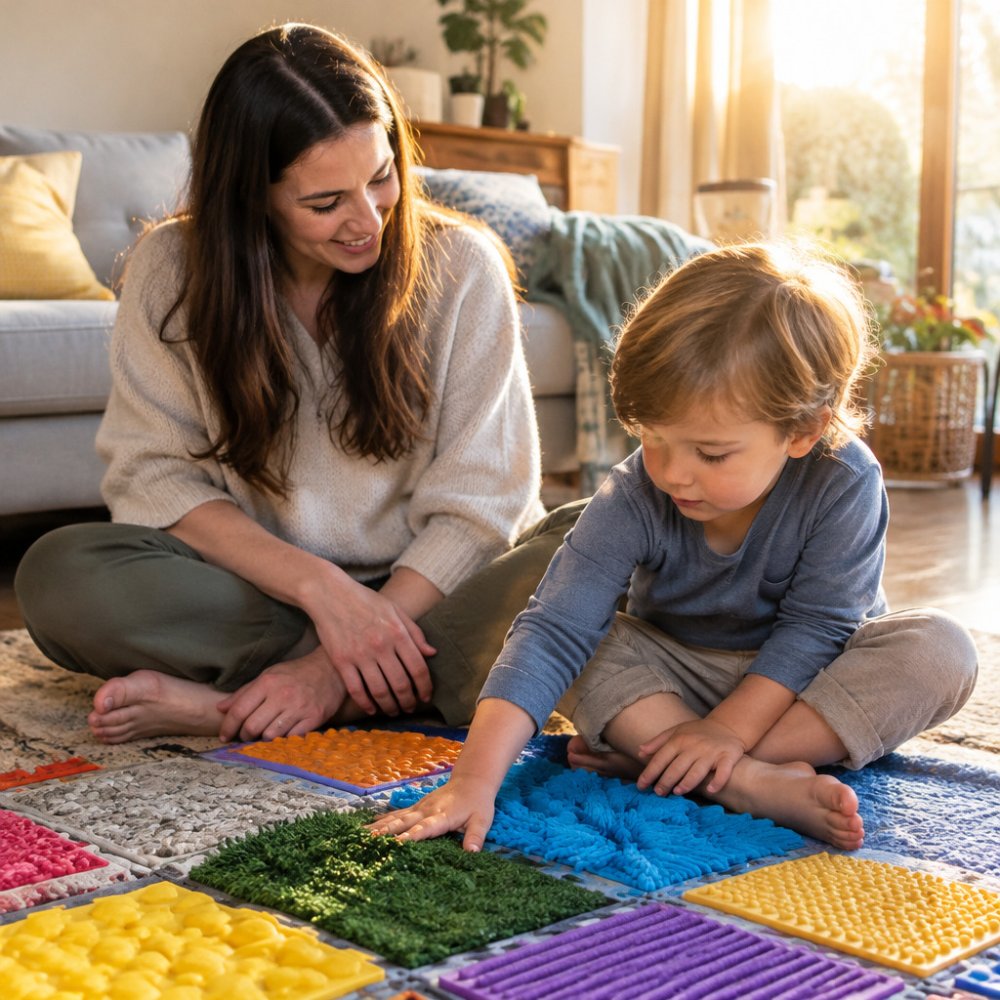
Over several weeks, you can:
- Place the mat in a familiar, low-traffic room.
- Sit beside the child rather than directing play.
- Introduce one new texture at a time.
- Keep sessions short and stop while the child still wants more.
- Note what the child approaches and what they avoid.
The Rainbow Sensory Playmat Set, with its mix of soft and firm pieces in bright colors, may suit a child who is comfortable with a simpler setup.
Sensory Play Mat Safety: Materials, Surfaces and Supervision
Safety should come before any playmat goes on the floor. Look for clear information about materials, age recommendations and cleaning. The playmat sets list their materials and safety features in the product details, including that they are phthalate-free, latex-free, waterproof and easy to wipe clean.
The playmat sets list a recommended age of 3 years and up with parental supervision. Keep an eye on small pieces, check the surface for wear, and clean the mats with water as directed. Supervision matters most when a child is exploring freely, so stay within reach.
The article lists the key safety and age details to check before a playmat goes on the floor.
| Safety check | What the article says | Practical note |
|---|---|---|
| Age recommendation | 3 years and up | Use with parental supervision |
| Materials | Phthalate-free, latex-free | Look for clear material statements |
| Cleaning | Waterproof, easy to wipe clean | Clean with water as directed |
| Small pieces | Keep away from young children | Inspect for loose parts and wear |
| Supervision | Stay within reach during free exploration | Watch closely while child explores |
Evidence, Realistic Expectations and When to Ask a Professional
It is worth separating what a playmat can reasonably do from what it cannot.
A realistic framing looks like this:
- Plausible and low-risk: offering texture variety, encouraging movement, and giving a child a predictable place to practice tolerating touch.
- Plausible but individual: calming or regulation effects. A surface can soothe one child and irritate another, so watch for signs of relaxation or distress rather than assuming a texture will work.
- Not supported: claims that a mat will resolve tactile defensiveness, improve attention, or replace therapy. Those outcomes depend on the child, the guidance, and the consistency of practice, not on the product alone.
Choosing textures and materials safely is part of realistic use. A practical selection framework:
- Texture intensity. Start with soft, low-contrast surfaces such as grass or a smooth tile, and add bumpy or pebbled pieces only when the child is comfortable.
- Material safety. Look for clear statements that the mat is phthalate-free and latex-free, and check the age recommendation. Many sets list 3 years and up with parental supervision.
- Cleaning and durability. Waterproof, wipe-clean surfaces are easier to keep hygienic, especially for bare feet and hands. Check seams and edges for wear over time.
- Choking and small parts. Inspect pieces for loose parts, cracks, or peeling edges, and keep small pieces away from children who still mouth objects.
- Slipping hazards. A mat that slides on hardwood or tile is a fall risk. Look for a grippy base or place the mat on a rug, and keep the surface dry.
Watch out: a mat that is safe for one child may not be safe for another. Age, mouthing behavior, and mobility all change the risk profile, so recheck the setup as your child grows.
Measuring comfort and progress is more useful than promising generalized improvement.
When to ask a professional: if touch sensitivity is intense, lasts a long time, or affects eating, sleep, dressing, or daily routines, talk with a pediatrician, an occupational therapist, or another qualified professional.
Starting Your Child's Sensory Mat Routine With the Right Set
Choosing the right set comes down to your child's current comfort level. A child who is just starting out may do best with a single soft piece or a compact set such as the Sensory Genius Sensory Mats, priced at $19.99. A child who already enjoys varied textures may be ready for the eleven-piece Ocean Sensory Playmat Set, priced at $104.95.
Start small, move slowly and let your child lead. We recommend choosing a set you can build on gradually rather than one that may overwhelm a child on day one. Browse our full range of sensory playmat sets to find the right starting point for your family.
Frequently Asked Questions
Why is sensory play beneficial for children?
Sensory play gives children structured chances to touch, press, balance and move across different surfaces. For kids with tactile sensitivity, repeated low-pressure exposure can make textures feel more predictable over time. Benefits typically include support for fine and gross motor skills, body awareness and self-regulation. Results vary by child, so treat sensory play as one supportive tool rather than a guaranteed fix, and talk with an occupational therapist if you have specific concerns about your child's development.
How do I introduce a sensory mat to a child who dislikes certain textures?
Start with the softest tile in the set and let your child look at it, touch it with a toy or a single finger, and step away whenever they want. Keep sessions to a few minutes and pair the mat with a favorite toy or song. Add one new texture only after the child stays relaxed with the previous one. Never force bare feet or hands onto a surface, since pressure often increases avoidance. Track how long your child engages to measure comfort and progress.
What should I look for when choosing a sensory play mat for a child?
Check the materials, the surface firmness and the safety testing claimed by the manufacturer. Look for non-toxic, phthalate-free and latex-free materials, plus anti-slip backing if the mat will be walked on. A mix of soft and firm tiles lets you offer gentle options alongside more intense ones. Consider size and the number of pieces so the set fits your floor space. Our Ocean Sensory Playmat Set includes 11 pieces with both soft and firm surfaces, priced at $104.95.
How can I make sensory play comfortable and safe for my child?
Keep play supervised, especially for children under three, and choose a clear floor area free of hard objects. Wipe mats with water as directed and check for wear or loose pieces regularly. Let your child set the pace and respect refusals without pressure. Use a low-cost option such as the Sensory Genius Sensory Mats at $19.99 to test which textures your child tolerates before investing in a larger set.
