
Last Updated: October 26, 2026
Quick Summary
Help a child with sensory seeking by observing when they crave movement, touch, or pressure, then building a sensory diet of planned activities across the day. Tracking patterns and adding regular movement breaks usually makes the biggest difference.
- Track when, where, and how your child seeks input for a few days before changing anything.
- Schedule two or three sensory activities at regular points, such as before breakfast, after school, and bedtime.
- Add movement like heavy work, obstacle courses, and swinging to meet steady sensory needs.
- Ask the school for movement breaks, a wiggle seat, and a quiet space, and put them in writing.
- Call a pediatrician or occupational therapist if safety, sleep, or daily routines are at risk.
Table of Contents
- What Sensory Seeking Means and How to Recognize It
- Step 1: Observe Your Child's Individual Needs and Track Patterns
- Step 2: Build a Sensory Diet for Children at Home
- Step 3: Add Movement and Active Play Through Sensory Seeking Activities for Kids
- Step 4: Address Sensory Processing Issues at School
- Step 5: Know When to Bring In Occupational Therapy for Sensory Processing Issues
- Booking Your Child's First Sensory-Friendly Support Plan
- Frequently Asked Questions
Sensory seeking is when a child needs more input from the senses than most kids do. Your child may spin, crash into furniture, chew on shirt collars, or jump all day because their body is asking for more movement, touch, or pressure.
At Doodlebug's Children's Boutique, we design sensory-friendly clothing and toys for kids who feel the world more intensely. The steps below show you how to read your child's signals and build a plan that works at home and at school.
What Sensory Seeking Means and How to Recognize It
Sensory seeking is a pattern where a child looks for strong sensory input. This input can come through touch, movement, sound, sight, or pressure. Some children seek this input because their nervous system needs it to feel calm and alert.
Sensory seeking is not bad behavior. It is the body's way of trying to feel balanced.
Common signs and examples of sensory seeking
Many parents notice these patterns first:
- Constant movement: Bouncing, jumping, or rocking when sitting still
- Crashing or bumping: Running into people or furniture on purpose
- Mouthing: Chewing on pencils, shirt collars, or fingers
A sensory-seeking child may look like they never stop moving. That constant motion often helps them focus and feel regulated.
Sensory seeking versus sensory avoiding
Some children do the opposite. A sensory-avoiding child pulls away from input that feels too strong. They may cover their ears at loud sounds or refuse tags and seams. Many children show both patterns in different situations. Watching which way your child leans helps you choose the right support.
Step 1: Observe Your Child's Individual Needs and Track Patterns
Before you change anything, watch your child for a few days. Write down what you see. Note the time, place, and what happened before and after.
Look for patterns such as:
- Which activities calm your child down
- Which settings cause overload or extra movement
- Which clothing textures bother them most
A simple tracking sheet can help:
- Time of day: Morning, after school, bedtime
- Setting: Home, classroom, store, playground
- Behavior: Jumping, chewing, crashing, pulling away
Tracking shows you what your child actually needs, not what you guess they need. Share your notes with teachers and therapists so everyone works from the same information.
Step 2: Build a Sensory Diet for Children at Home
A sensory diet is a set of planned activities that give your child regular sensory input through the day.
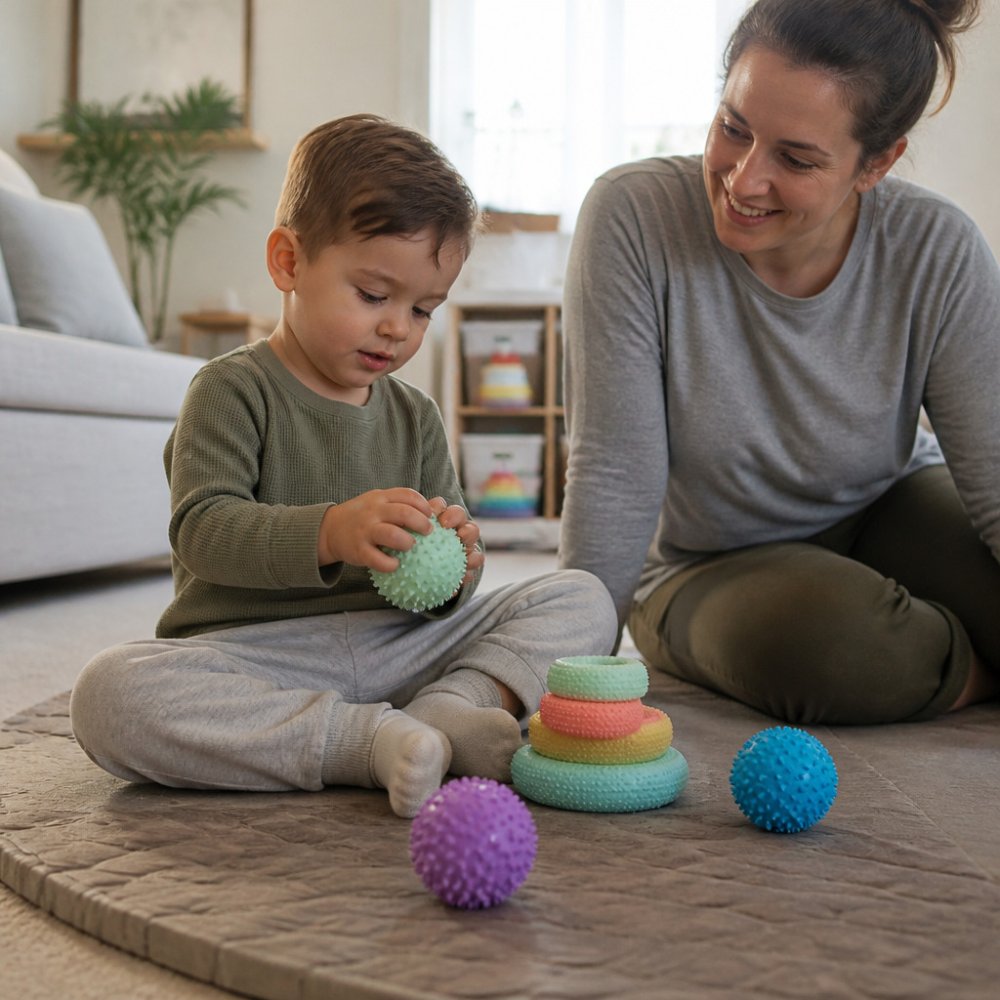
Here is how to start:
- Pick two or three activities from your tracking notes.
- Schedule them at regular points, such as before breakfast, after school, and before bed.
- Use calming input when your child feels overloaded and alerting input when they feel sluggish.
- Check in after one to two weeks and adjust.
Many families keep a sensory tool basket near the couch or homework area. The Sensory Genius Sensory Mats ($19.99) can give tactile input for hands and feet during quiet time.
Products mentioned in this step can support different sensory needs at home, as summarised below.
| Product | Price | Use |
|---|---|---|
| Sensory Genius Sensory Mats | $19.99 | Tactile input for hands and feet during quiet time |
| Balance Cushion Sensory Seat by Bouncyband® | $32.99 | Lets kids move while they sit |
| Comfy Cozy Peapod Inflatable Chair for Kids | $89.99 | Deep pressure during reading or homework |
Step 3: Add Movement and Active Play Through Sensory Seeking Activities for Kids
Movement is one of the strongest sources of sensory input. Sensory seeking activities for kids can be simple and fun:
- Heavy work: Pushing a laundry basket, carrying books, or wall push-ups
- Obstacle courses: Crawling under chairs, hopping on cushions, and rolling on mats
- Jumping and hopping: Jumping on a trampoline or hopping between marks on the floor
For children who need a lot of input, the Comfy Cozy Peapod Inflatable Chair for Kids ($89.99) offers deep pressure that many kids find calming during reading or homework. Pair movement breaks with quiet activities to help your child switch gears.
Step 4: Address Sensory Processing Issues at School
School can be hard for a sensory-seeking child. Long periods of sitting, noisy hallways, and scratchy uniforms all add up. Most guides stop at a bullet list of classroom accommodations, but the piece that actually changes outcomes is a shared plan that travels between home and school. A child who gets a movement break at 10 a.m. at school and a heavy-work chore at 4 p.m. at home is getting steady input instead of a single burst, and that only happens when the adults compare notes.
Start with the accommodations that are easiest to approve
Talk with the teacher about specific supports, such as:
- Movement breaks between lessons, ideally before the child reaches the point of climbing out of the seat
- A wiggle seat or standing-desk option for seated work
- Quiet fidget tools that stay in the child's lap or pocket and do not become a distraction
Many schools use a 504 plan or an individualized education program (IEP) to put supports in writing. A 504 plan covers accommodations that give a student equal access to the classroom; an IEP provides specialized instruction and related services and is used when a child qualifies under a specific category. Ask your school which process fits your child, and put the request in writing so there is a dated record.
Test any fidget or wiggle seat at home first. A tool that is too loud, too bouncy, or too novel can make the classroom harder for your child and more distracting for the class. A quiet, low-profile option that your child ignores after a week is usually the right one.
Build a one-page shared plan
A shared plan does not need to be long. One page that both the caregiver and the teacher can see is enough. Include:
- The child's signals: what early escalation looks like (pacing, chewing a collar, pushing into walls) and what it looks like when the child is regulated
- The daily sensory schedule: the movement or pressure activities already happening at home and the times they occur
- The school-side supports: which accommodations are in place and when they are used
A simple communication template can be as short as: Date, activity tried, what we saw, what we will try next. Caregivers and teachers fill in the same three fields so the notes are comparable week to week.
Coordinate without overloading the teacher
Teachers manage many students, so keep requests specific and low-effort. Instead of asking for a daily report, ask for a two-line note on the days the child's regulation clearly changed. Offer to supply the tools (wiggle seat, fidget, chewelry) so the school does not have to source them. Share your tracking notes from Step 1 so the teacher can see which activities already calm your child at home and can try the same ones at school.
Ask the teacher which part of the day is hardest. The answer is often a specific window, right after lunch, during silent reading, or at the end of the day, and a single well-timed movement break in that window can do more than several scattered ones.
Step 5: Know When to Bring In Occupational Therapy for Sensory Processing Issues
Occupational therapy for sensory processing issues helps families and schools build a plan based on a child's exact needs. An occupational therapist can observe your child, run assessments, and suggest specific activities. Most guides tell you to "seek help if behaviors interfere with daily life" and stop there. The more useful version is a safety check, a simple way to measure whether your current plan is working, and a clear picture of what an evaluation actually involves.
Make the activities safe first
Sensory-seeking children often seek intensity, so the job of the adult is to provide strong input without injury. A few rules cover most situations:
- Crashing and jumping: direct the child toward a crash pad, mattress, or cushion pile rather than furniture, walls, or people. Set a clear boundary, "we crash on the mat, not on the couch", and practice it.
- Spinning and swinging: limit spinning to short bursts and watch for dizziness, nausea, or pale skin. Stop immediately if the child looks unsteady or complains of a headache.
- Chewing and mouthing: replace unsafe items (pencils, shirt buttons, small toys) with a dedicated chewelry or chew tool that is appropriate for the child's age and cleaned regularly.
Some behaviors need a call to the pediatrician rather than a home activity plan: head-banging or hitting that leaves marks, biting that breaks skin, climbing that risks a fall from height, ignoring pain or injury, or a sudden change in sensory behavior. These are not reasons to panic, but they are reasons to get a professional opinion.
Track outcomes instead of guessing
A generic activity list cannot tell you whether your plan is working. A simple record can. Once a week, note three things for a few representative moments:
- The trigger: what happened just before (transition, loud room, hunger, poor sleep)
- The activity you used: movement break, deep pressure, quiet space, chew tool
- The outcome: did the child return to participation, stay escalated, or need something different
Look for changes in participation rather than in the behavior itself. A child who rejoins homework after a movement break, or who sits through a meal without leaving the table, is showing progress even if the seeking behavior continues. Bring these notes to any professional appointment, they are far more useful than a general description.
Consider a professional evaluation if
- Sensory behaviors interfere with sleep, eating, learning, or safety
- Your child becomes unsafe, such as climbing dangerously or ignoring pain
- Routines at home or school keep breaking down despite a consistent plan
- Your child's needs change quickly over time, or new behaviors appear
Your child's pediatrician can help you find an occupational therapist and can rule out other causes. Movement and sensory-seeking behavior can also overlap with fatigue, stress, communication needs, or attention differences, so a professional can help separate what is sensory from what is something else, without labeling your child.
You do not need a diagnosis to start observing, tracking, and building a safe sensory routine. You do need a professional when safety is at risk, when daily life keeps breaking down, or when you want an assessment to guide the next step. Bring your tracking notes to that first appointment.
Booking Your Child's First Sensory-Friendly Support Plan
Helping a child with sensory seeking takes patience and steady routines. Start with observation, build a simple sensory diet, add movement, and bring in the school team when needed. At Doodlebug's Children's Boutique, we offer sensory-friendly clothing and toys that make daily life feel more comfortable for your child. Browse the collection to find tools that fit your child's routine.
Frequently Asked Questions
What are common sensory-seeking behaviors in children?
Sensory-seeking children look for more input than most kids need. Common signs include constant movement, crashing into furniture or people, jumping, spinning, chewing on clothing or pencils, touching textures repeatedly, and loud vocalizing. Some children also prefer tight clothing, deep hugs, or heavy blankets.
How can I help my child who constantly seeks movement or touch?
The Balance Cushion Sensory Seat by Bouncyband® is described as allowing kids to move while seated. The Comfy Cozy Peapod Inflatable Chair is described as providing soothing deep pressure and as suitable for reading, studying, or relaxing.
When should I seek professional help for my child's sensory-seeking behaviors?
Consider a professional evaluation if sensory-seeking behaviors cause injury, interfere with sleep, eating, or friendships, or lead to frequent meltdowns that routines do not reduce. Also seek help if your child's behavior seems to be driven by anxiety, attention difficulties, or another developmental concern. Your pediatrician can provide a referral to an occupational therapist, who can assess sensory processing and recommend a tailored plan. Early support often makes daily routines easier for the whole family.
