Last Updated: November 6, 2026
Quick Summary
Tactile learning games for preschoolers build fine motor control, vocabulary, and body awareness through hands-on touch play. Sensory bins, threading, textured mats, and homemade playdough each target a specific skill, and matching a game to your child's readiness matters more than age alone.
- Sensory bins use shallow bases like rice or sand with scoops and hidden objects to build vocabulary and focus.
- Threading, pinching, and stacking build the pincer grasp and hand-eye coordination that handwriting depends on.
- Free games like texture hunts, ice exploration, and oobleck need only household supplies and no purchases.
- Keep sensory bin fillers shallow, around an inch deep, so small hands can scoop without frustration.
- Textured mats are recommended for ages three and up with parental supervision.
Table of Contents
- Why Tactile Learning Games Matter for Preschool Development
- Tactile Activities for Preschoolers: A Quick Comparison
- Sensory Bins and Discovery Play That Build Vocabulary and Focus
- Fine Motor Sensory Activities for Preschoolers: Threading, Pinching, and Stacking
- Textured Play Mats and Barefoot Games for Balance and Body Awareness
- Free Tactile Learning Games for Preschoolers You Can Set Up at Home
- Preschool Sensory Activities Printable: Sorting, Matching, and Letter Games
- Choosing Tactile Toys and Mats at Doodlebug's Children's Boutique
- Frequently Asked Questions
Why Tactile Learning Games Matter for Preschool Development
Tactile learning is the process of gaining knowledge through touch, and it sits at the center of how preschoolers build fine motor control, vocabulary, and body awareness. At Doodlebug's Children's Boutique, we hear from parents every week who want activities that do more than pass the time. The hands-on games below are chosen because each one targets a specific skill, from pincer grasp to sensory regulation.
Many preschoolers stay engaged when their fingers are busy. Squeezing, scooping, pinching, and threading give steady physical feedback, and this kind of practice supports the small muscles and coordination children use for writing later.
Below, we break down nine tactile activities, what each one develops, and how to adapt them for sensitive or reluctant kids. Watch out: matching a game to your child's readiness matters more than age alone, so read the adaptation notes before you set anything up.
Tactile Activities for Preschoolers: A Quick Comparison
Here is a quick look at the tactile activities for preschoolers we cover, what each one builds, and how much setup it needs.
| Activity | Main Skill | Setup Time | Mess Level |
|---|---|---|---|
| Sensory bins | Vocabulary, focus | 10 min | Medium |
| Threading and stacking | Fine motor, precision | 5 min | Low |
| Textured mats and barefoot games | Balance, body awareness | 2 min | None |
| Homemade playdough | Hand strength, calming | 15 min | Medium |
| Free household games | Sorting, counting | 5 min | Low |
| Printable sorting and letter games | Letter recognition | 5 min | Low |
Setup Time
Use this table to pick by how much time and cleanup you can handle today. A low-mess option still delivers real tactile input.
Sensory Bins and Discovery Play That Build Vocabulary and Focus
Sensory bins are shallow containers filled with a tactile base such as rice, dried quinoa, or sand, plus small scoops and hidden objects for children to find. They work because discovery play keeps hands busy while the brain sorts, names, and compares what it touches.
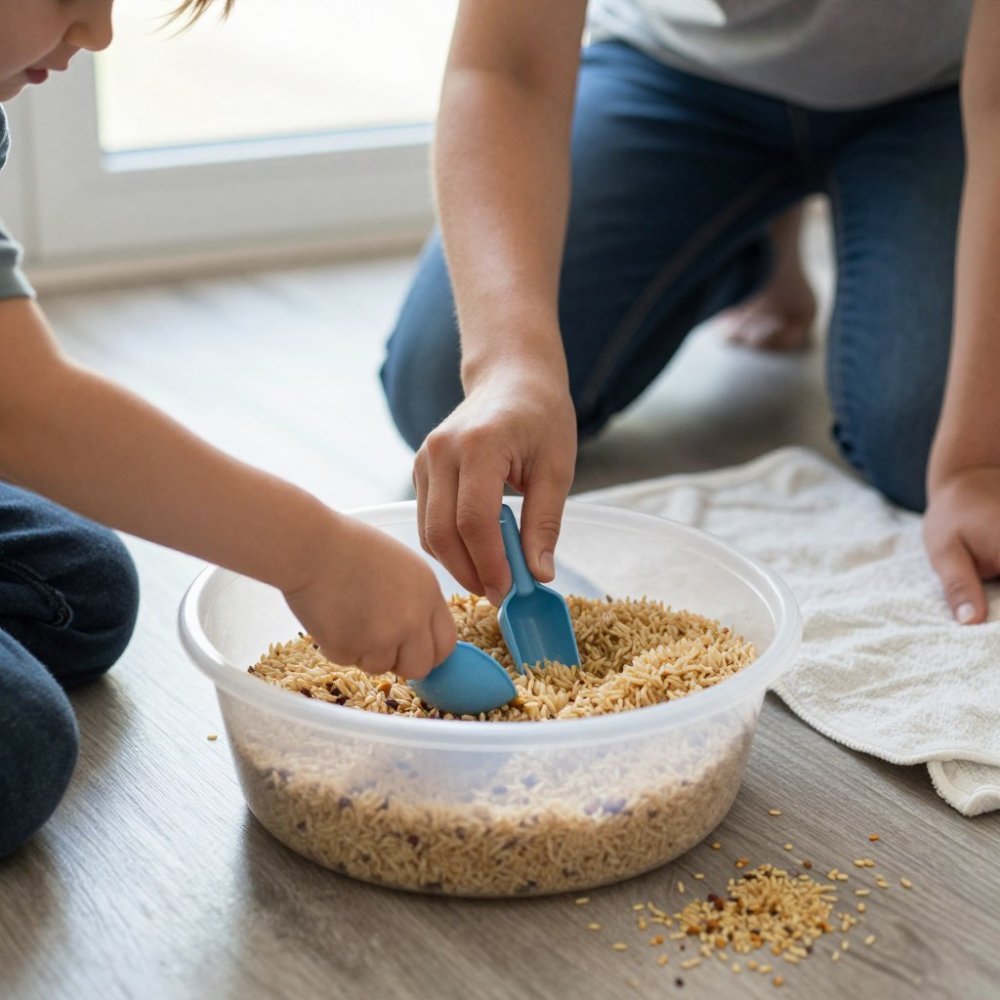
A rice bin is the easiest starting point. Fill a bin with a few cups of uncooked rice, add measuring cups and a few toy animals, and let your child dig.
Match the base to the skill. Different fillers pull for different developmental targets:
- Dry rice or quinoa: best for scooping, pouring, and vocabulary; low allergy risk and easy to sweep.
- Play sand: heavier resistance builds hand and forearm strength; messier and needs a tarp underneath.
- Dried beans or chickpeas: excellent for sorting and counting by size and color; the largest choking risk of the common fillers, so reserve for children past the mouthing stage.
- Shredded paper or fabric scraps: the lowest-mess option and a good bridge for children who dislike granular textures.
Safety and hygiene come first. Loose fillers are a choking hazard, so supervise closely and keep bins away from children under three or any child who still mouths objects.
Allergy and sensitivity notes. Food-based fillers can be a problem in homes and classrooms with allergies, and scented or dyed fillers can bother children with sensory sensitivities.
Adapt by readiness, not just age. Younger preschoolers do best with one filler, two tools, and a single hidden object. Older preschoolers can handle a mixed bin, a sorting task, and a counting challenge such as "find all five and tell me how many are blue." A child who needs a simpler task can scoop and pour without a hunt; a child who needs more challenge can sort by two attributes at once. Cleanup is part of the routine: keep a towel or mat under the bin, use a rimmed tray for pouring, and store the base in a lidded container so the next setup takes minutes rather than a full reset.
Fine Motor Sensory Activities for Preschoolers: Threading, Pinching, and Stacking
Fine motor sensory activities for preschoolers target the small muscles in the hands and fingers. Threading beads, pinching clothespins, and stacking blocks all build the pincer grasp and hand-eye coordination that handwriting depends on.
Try these three in rotation:
- Threading: large beads onto a shoelace or pipe cleaner, which builds precision and control. Start with a stiff pipe cleaner and a wide bead; move to a floppy lace and smaller bead only when control improves.
- Pinching: moving cotton balls with tweezers or tongs into a bowl. This isolates the thumb-and-finger pinch and builds the grip strength that supports handwriting.
- Stacking: balancing blocks, which teaches gentle pressure and spatial awareness. Weighted or wobbly pieces add a feedback challenge because the child must adjust grip and pressure with every stack.
The Tobbles Neo stacking toy has weighted pieces designed to wobble and balance, which invites children to adjust their grip and pressure with each stack. A common mistake is starting with beads that are too small; choose oversized beads until control improves.
Adapt to readiness. Younger preschoolers do best with the largest beads, a stiff lace, and a wide-mouth bowl for the pinch task.
Inclusive and sensory-friendly variations. For children who avoid certain textures, offer tool-assisted versions: tongs instead of fingers, a spoon instead of a pinch, or a tray that keeps materials contained.
Safety and setup. Small beads and parts are a choking hazard, so supervise closely and keep loose pieces out of reach of children under three or any child who mouths objects.
Textured Play Mats and Barefoot Games for Balance and Body Awareness
Textured play mats give feet and hands a range of surfaces to explore, which builds body awareness and balance. Barefoot games on varied textures send strong feedback to the brain and help children sense where their body is in space.
Lay out mats with different surfaces and turn movement into a game: hop from the bumpy tile to the smooth one, or play "the floor is lava" by stepping only on certain textures. The Rainbow Sensory Playmat Set combines soft and firm surfaces in eight pieces, which suits this kind of color-and-texture game. The Tots Sensory Playmat Set is made up of soft mats. The Ocean Sensory Playmat Set adds an ocean theme for imaginative play. These mats are recommended for ages three and up with parental supervision.


Free Tactile Learning Games for Preschoolers You Can Set Up at Home
Free tactile learning games for preschoolers need nothing more than what is already in your kitchen. The goal is texture exploration and sorting, not fancy supplies.
Try these no-cost setups:
- Texture hunt: gather five household materials, such as a sponge, foil, a towel, and a wooden spoon, and have your child sort them from rough to smooth.
- Ice exploration: freeze small toys in a tray of water and let your child free them with warm water and fingers.
- Oobleck: mix cornstarch and water for a gooey texture that pours and firms up in the hand.
- Color sorting: sort buttons or bottle caps by color into bowls.
Each game builds tactile discrimination and counting without a single purchase. Rotate them weekly so novelty keeps interest high.
Preschool Sensory Activities Printable: Sorting, Matching, and Letter Games
A preschool sensory activities printable pairs a paper task with a tactile element, so children match, sort, or trace while their hands stay active. Print simple sorting mats or letter cards, then add texture by having children place small objects on each shape.
For letter recognition, print large letter outlines and let children fill them with buttons, beans, or playdough. For matching, print pairs of textured cards and have children find the matches by feel alone. These printables work well for quiet time and travel, and they build shape and letter recognition alongside fine motor skills. Keep pieces large enough to avoid choking risk, and supervise children under three closely.
Choosing Tactile Toys and Mats at Doodlebug's Children's Boutique
Choosing the right tactile tools comes down to your child's sensitivities, age, and how much mess you can manage. At Doodlebug's Children's Boutique, we offer sensory-friendly toys and mats, so families can browse options suited to their child's needs. Before you buy a mat, our guide on how to choose sensory playmats for tactile-sensitive kids walks through the questions worth asking first.
For stacking and pinching play, the Tobbles Neo stacking toy supports fine motor development. The Rainbow Sensory Playmat Set offers soft and firm surfaces, and the Tots Sensory Playmat Set offers soft surfaces for younger children.
Tactile play does not need to be complicated or expensive to make a real difference in your child's development. If you are ready to build a sensory-friendly play space, Doodlebug's Children's Boutique can help with sensory-friendly toys and mats, tag-less apparel for sensitive kids, and fidget tools designed for focus and calm. Get started with Doodlebug's Children's Boutique and give your child tactile tools that support comfort and confidence every day.
Frequently Asked Questions
What are tactile learning activities for preschoolers?
Tactile learning activities are games where children learn through touch: scooping rice in a sensory bin, pressing homemade playdough, sorting textured blocks, or walking barefoot on bumpy mats. The common thread is hands-on contact with varied surfaces, which supports tactile discrimination, fine motor skills, and hand-eye coordination. You do not need special equipment to start. A dishpan of dry oats, a set of stacking cups, and a towel on the floor cover the basics, and you can add structured toys like textured mats as your child's interests grow.
How does tactile play support preschool development?
Touch is one of the first ways young children gather information about the world, and tactile play turns that into practice for other skills. Pinching, squeezing, and pouring strengthen the small hand muscles used later for holding a pencil. Sorting by texture or color builds classification and early math thinking. Sensory bins and textured mats also give children calming input that can help them settle and focus. Tactile play is often linked with fine motor, language, and sensory development, which is why many preschool teachers include it in daily routines.
How can I encourage a preschooler who avoids messy play?
Start dry. A rice bin, a basket of smooth stones, or a texture hunt with fabric squares gives tactile input without sticky hands. Offer tools like scoops and tongs so your child can touch the material indirectly at first, and keep a damp towel within reach so cleanup is instant. Let your child watch you play before joining in, and stop while it is still fun. Many children who resist finger paint will happily press shapes into firm playdough or walk on a textured mat, so rotate materials until you find the ones your child tolerates.
What materials are safe for tactile play with preschoolers?
Choose non-toxic, age-appropriate materials and supervise closely, especially with children under three who mouth objects. Small items like beads, dry beans, and coins are choking hazards, so swap in larger alternatives such as jumbo threading beads or rolled playdough snakes. Check labels for phthalate-free and latex-free claims on toys and mats, and wash hands after play. Homemade playdough and oobleck are safe if your child no longer puts everything in their mouth. Store sensory bin fillers in sealed containers and inspect them for moisture before each use.
Can tactile activities help preschoolers develop fine motor skills?
Yes. Fine motor sensory activities for preschoolers target the exact muscles and coordination children need for writing, dressing, and self-feeding. Threading beads, pinching playdough, stacking weighted pieces like Tobbles Neo, and squeezing textured blocks all build a pincer grasp and hand strength. Hand-eye coordination improves when children aim a scoop into a cup or fit puzzle pieces together. Ten to fifteen minutes of focused tactile play a few times a week adds up, and the repetition matters more than the length of any single session.
